Discover Pinterest trends 2026, Pinterest SEO strategies, AI-powered tools, and visual search tips to grow your business, boost traffic, and increase sales. Pinterest is a visual search engine and not just a social media site. on Pinterest users can plan, sightsee, and make purchases. Unlike feed-oriented platforms centered around who you follow, Pinterest’s search-based approach enables a small business, an autonomous creator, or a beginner to be found by individuals who have never encountered their brand formerly, purely because their content aligned with a search query. By 2026, this search behavior is being converted by three synchronized impacts: enhanced Pinterest SEO signals, better visual search technology, and AI tools combined into the platform. This guide details the particular transformations taking place, what stays the same, and how businesses, content creators, and marketers can utilize Pinterest as an authentic tool for advancement.
What Are the Biggest Pinterest Trends in 2026?
Several shifts characterize the Pinterest trends in 2026:
• Enhanced Pinterest SEO principles: Status depends less on operating the algorithm and more on aligning genuine search intent with clear, transparent content. By using Pinterest SEO strategy helps the beginners align their content with the intent.
• Expansion of visual search: A growing number of users are utilizing images and screenshots for searches instead of typed keywords, prompting Pinterest’s systems to “read” the pin itself rather than just its text.
• AI-supported discovery and creation: Pinterest AI match content with searches, while creators utilize AI upfront to accelerate idea generation and content development.
• Tailored recommendations and user-directed topics: Pinterest is authorizing users with greater control over their content visibility, increasing the importance of niche relevance.
• Product discovery and shopping: Product Pins, catalogs, and shopping capabilities continue to develop as Pinterest becomes more entrenched in commerce.
• Content planning based on trends: Pinterest’s own trend forecasting (Pinterest Predicts) reveals that trends emerge on the platform months prior to mainstream exposure, providing proactive brands a significant edge.
• Growth for creators and businesses: Small to medium-sized brands are increasingly viewing Pinterest as a cost-effective, supportable traffic source rather than solely a paid advertising avenue.
Why Pinterest Matters for Businesses in 2026
Pinterest distinguishes itself from platforms such as Instagram and TikTok by the deliberate intentions of its users. Visitors primarily utilize the site for organizing events like weddings, redecorating their spaces, discovering recipes, or searching for gifts, rather than aimlessly scrolling. This is a great Pinterest business marketing and focused engagement offers various important advantages for companies:
• Search-driven traffic: Pins can remain visible in search results for months or even years after they are initially posted, unlike social media updates that quickly lose visibility within days.
• Product discovery: Users are actively seeking products and ideas, making Pinterest a prime platform for e-commerce and lifestyle brands.
• Brand awareness: Consistent visual branding on pins enables users to identify a brand before even visiting its website.
• Website traffic: Well-optimized pins can direct clicks straight to blogs, product pages, and landing pages.
• E-commerce opportunities: Shopping features streamline the transition from inspiration to purchase, reducing the number of steps involved.
• Evergreen content: A single well-optimized pin can continue to generate impressions long after new content has emerged elsewhere.
• Visual marketing advantage: In sectors that rely heavily on visuals, such as fashion, food, home decor, travel, and weddings, Pinterest generally surpasses text-centric platforms.
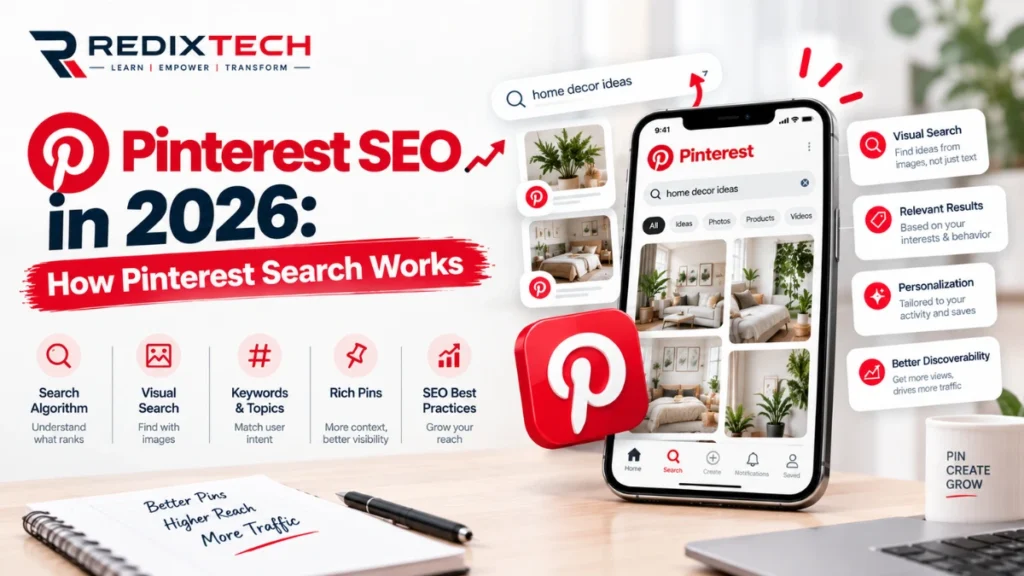
Pinterest SEO in 2026: How Pinterest Search Works
Pinterest SEO includes utilizing suitable keywords and a clear construction for content to guarantee that pins appear when users search applicable topics. Although the Pinterest SEO strategy is straightforward, execution it requires consistent effort.
Businesses can enhance their presence by optimizing the following elements:
• Profile name and username: Integrate a keyword that signifies the services offered by the business, in addition to the brand name.
• Bio: A concise and clear summary that seamlessly incorporates relevant search terms.
• Board names and descriptions: Clearly defined board titles rich in keywords assist both users and Pinterest in understanding what each board features.
• Pin titles and descriptions: Provide clear and descriptive text that aligns with actual search behavior.
• Image text overlays: Brief, easy-to-read text on the pin image itself enhances clarity and searchability.
• Relevant keywords throughout: Incorporate them organically, avoiding overuse.
In 2026, a significant pivot is evident as Pinterest increasingly favors natural, specific language instead of keyword stuffing. For example, a board titled “Coastal Farmhouse Decor” is more effective than a general title like “Home Design,” as it aligns better with specific search intent. Additionally, Pinterest considers credibility factors such as an engaging account, a verified and claimed website, and descriptions that accurately convey the pin’s content when determining rankings.
How to Find Keywords on Pinterest
Performing Pinterest keyword research doesn’t require expensive tools. A straightforward, repeatable approach is effective:
- Start with a broad theme connected to the business (like “meal prepping” or “wedding decor”).
- Use the Pinterest search bar and observe the suggested search phrases that come up, as these reflect ongoing, popular searches.
- Review the suggestions listed beneath the search bar or within the results feed for phrases that are similar.
- Discover related terms by looking at adjacent boards and high-performing pins in your area of interest.
- Organize keywords by their topic and intent, differentiating between general terms and specific, long-tail phrases.
- Integrate keywords organically into pin titles, descriptions, and board names instead of uniformly reusing the same expression.
Additionally, Pinterest’s complimentary Trends tool is beneficial in this regard, it illustrates how the interest in certain terms has fluctuated over time, helping to assess whether a keyword is on the rise, stable, or declining before creating content centered around it.
Pinterest Visual Search in 2026
Visual search indicates that Pinterest can recognize objects, colors, patterns, and styles directly from an image, rather than solely from the associated text. Rather than searching for “blue floral summer dress,” a user can capture a screenshot of a similar dress and allow Pinterest to locate visually comparable pins and this how you grow on Pinterest.
For companies, this alters the meaning of “optimization”:
• High-quality, clear images are increasingly important because Pinterest’s visual systems are essentially interpreting the image itself.
• Product photography should clearly depict the item, avoiding excessive text overlays that obscure key visual aspects.
• Consistent, well-lit, and accurately represented images assist Pinterest in properly categorizing and matching content to visual searches.
• Various angles and contextual images (showing a product in use, rather than just on a plain background) can enhance broader visual discovery.
Ultimately, visual search favors businesses that consider their pins as authentic product or lifestyle photography, rather than merely marketing visuals filled with text.
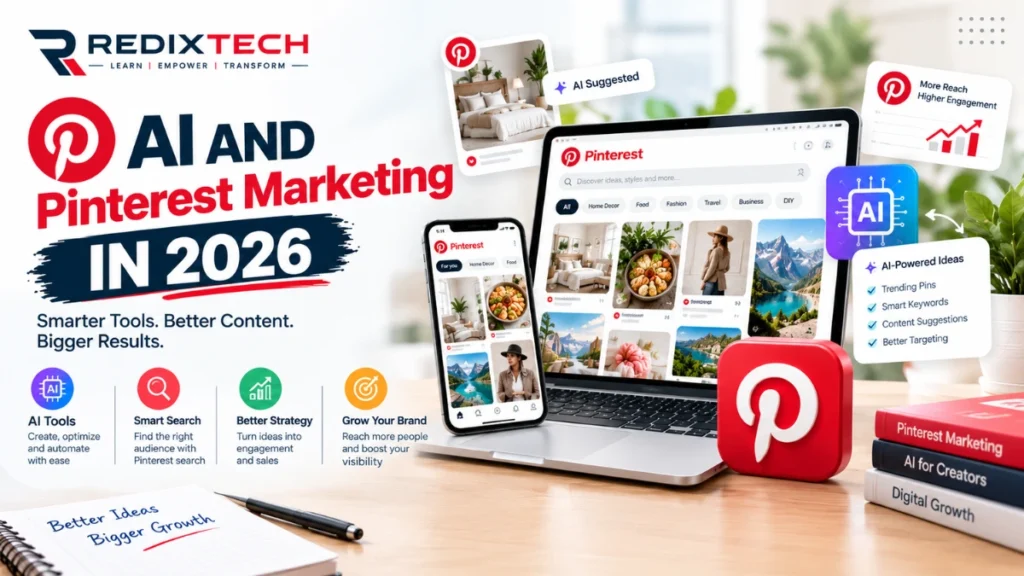
AI and Pinterest Marketing in 2026
AI has emerged as a useful helper for Pinterest marketers instead of being a substitute for strategy. Marketers are utilizing AI tools to assist with:
• Content ideas: Providing initial suggestions for boards, pin themes, or seasonal promotions.
• Keyword research: Accelerating the identification of associated search terms and phrases.
• Pin titles and descriptions: Creating initial drafts that a human can then edit and improve.
• Content calendars: Planning what to publish and when, in accordance with seasonal trends.
• Image concepts: Generating visual ideas prior to execution by a designer or photographer.
• Trend research: Summarizing trends from extensive data sets.
• Performance analysis: Analyzing analytics to identify effective elements more swiftly than solely manual reviews.
The essential point: AI should enhance creativity and strategic thought, not substitute for original content. Pinterest’s ranking algorithms prefer genuine, precise content, and generic AI-generated descriptions that do not accurately reflect the actual product or experience usually do
Pinterest Trends: How to Find Trending Topics
Beyond individual keyword research, Pinterest publishes broader trend forecasting that marketers can use to plan ahead. This includes:
- Rising topics: Searches gaining momentum quickly.
- Seasonal searches: Predictable spikes tied to holidays, seasons, and annual events.
- Popular keywords: Consistently high-volume search terms within a niche.
- Audience interests: How different age groups and demographics engage with specific trends.
- Content opportunities: Gaps where demand is rising but supply of quality content is still low.
Seasonal planning deserves special attention. Categories like Ramadan, Eid, home decor, fashion, recipes, and gift guides follow predictable annual patterns but because Pinterest content can take time to gain traction, businesses need to publish seasonal content well before peak demand, not once the season has already arrived.
How to Create Pinterest Pins That Get Attention
A well-designed pin combines clarity with strong visual hierarchy:
- Vertical format: Taller, vertical images perform better in the Pinterest feed than square or horizontal ones.
- High-quality images: Sharp, well-lit visuals stand out while scrolling.
- Strong headlines: A short, clear headline overlay communicates the pin’s value at a glance.
- Clear visual hierarchy: The most important element (product, headline, or result) should draw the eye first.
- Consistent branding: Recognizable fonts, colors, or logo placement build familiarity over time.
- Relevant keywords: Both in the overlay text and in the pin’s written description.
- Strong calls to action: Phrases like “Read the full guide” or “Shop the collection” tell users what to do next.
- Mobile-friendly design: Most Pinterest browsing happens on phones, so text needs to be legible at small size.
Pinterest Boards: How to Organize Your Content
Boards are more than folders they are a signal Pinterest uses to understand a business’s niche. Effective board organization includes:
- Niche-specific boards: Narrow, well-defined topics rather than broad, catch-all categories.
- Keyword-rich board names: Descriptive titles that reflect how customers actually search.
- Useful board descriptions: A short paragraph explaining what the board covers, using natural keyword phrasing.
- Logical organization by topic: Grouping pins so each board tells a coherent, focused story.
- Avoiding unrelated content: Mixing unrelated pins into a board dilutes its relevance and can confuse both users and Pinterest’s ranking systems.
Pinterest Video & Short-Form Content Trends
Short-form video continues to grow on Pinterest, mirroring a broader shift across social platforms. Businesses are using video for:
- Short videos: Quick, engaging clips that stand out in the feed.
- Tutorials: Step-by-step demonstrations that build trust and authority.
- Product demonstrations: Showing an item in use, not just in a static photo.
- Before/after content: Especially effective for home improvement, beauty, and fitness niches.
- Step-by-step content: Breaking down a process visually, which performs well for recipes and DIY projects.
- Behind-the-scenes content: Humanizing a brand and building audience connection.

Pinterest for E-Commerce in 2026
E-commerce brands have some of the clearest use cases on Pinterest. The platform supports:
- Product discovery: Users actively browse for items to buy, not just to admire.
- Product Pins: Pins that can display up-to-date product information pulled from a business’s website.
- Catalogs: Bulk product uploads that let an entire inventory become discoverable.
- Shopping features: Tools designed to move users from a saved pin toward checkout.
- Website traffic: Pins that link directly to product and category pages.
- Product inspiration: Lifestyle and “how to style it” content that surrounds a product with context.
- Conversions: A shorter path from discovery to purchase compared with many other platforms.
Because shopping features and eligibility requirements can change, businesses should check Pinterest’s official Business Help Center for the most current details before setting up catalogs or product tagging.
How to Grow Your Business With Pinterest in 2026
A practical, repeatable growth strategy looks like this:
- Create a Pinterest Business account to unlock analytics, ads, and shopping features.
- Optimize your profile with a clear name, keyword-rich bio, and claimed, verified website.
- Research keywords using the Pinterest search bar, guided search suggestions, and the Trends tool.
- Create niche-specific, keyword-rich boards that mirror how customers actually think about your products.
- Publish high-quality pins consistently, rather than posting in bursts and then going quiet.
- Use trending topics identified through Pinterest Predicts and the Trends tool, planned well ahead of peak season.
- Link pins to relevant pages on your website product pages, blog posts, or landing pages that match the pin’s promise.
- Test different creative formats, including static pins, carousels, and short videos, to see what resonates with your audience.
- Improve based on analytics, tracking which pins, boards, and keywords are actually driving traffic and saves.
- Stay consistent, since Pinterest rewards accounts that pin regularly over accounts that post sporadically.
Pinterest Analytics: What Metrics You Should Track
Understanding performance data helps identify what deserves more attention. Key metrics include:
- Impressions: How many times your pins were shown.
- Pin clicks: How many times users clicked into a pin’s close-up view.
- Outbound clicks: How many users clicked through to your website.
- Saves: How often users saved your pin to their own boards a strong signal of relevance.
- Engagement: Overall interaction with your content, including clicks and saves combined.
- Engagement rate: Engagement relative to impressions, useful for comparing pins of different reach.
- Audience insights: Demographic and interest data about who is engaging with your content.
- Top-performing pins: Identifying your best pins helps you understand what to repeat or repurpose.
Reviewing analytics regularly rather than only at the end of a campaign makes it easier to catch which content deserves more promotion and which boards need a refresh.
Common Pinterest Marketing Mistakes to Avoid
Many accounts underperform not because Pinterest is difficult, but because of avoidable mistakes:
- Ignoring Pinterest SEO entirely and treating pins like generic social posts.
- Using poor-quality images that don’t hold up in a visual-first feed.
- Keyword stuffing instead of writing natural, specific descriptions.
- Posting irrelevant content that doesn’t match a board’s stated topic.
- Linking to broken or unrelated pages instead of the specific page a pin promises.
- Inconsistent publishing, posting heavily and then disappearing for weeks.
- Ignoring trending topics and missing seasonal windows entirely.
- Using clickbait that doesn’t match what the linked page actually delivers.
- Not checking analytics, so underperforming content keeps getting repeated.
- Copying competitors instead of building an original, recognizable visual style.
Frequently Asked Questions
What are the biggest Pinterest trends in 2026?
The biggest trends include stronger Pinterest SEO fundamentals, growing use of visual search, AI-assisted content planning, more personalized and user-controlled recommendations, and continued growth in shopping and product discovery features.
Is Pinterest good for business in 2026?
Yes. Pinterest’s search-driven, high-intent audience makes it especially useful for e-commerce, lifestyle, and content-based businesses looking for long-lasting organic traffic rather than short-lived social reach.
What is Pinterest SEO?
Pinterest SEO is the practice of optimizing a profile, boards, and pins with relevant keywords and clear descriptions so content appears when users search for related topics.
How does Pinterest visual search work?
Pinterest’s visual search technology analyzes the actual content of an image objects, colors, and styles allowing users to search using a picture or screenshot instead of typed keywords.
How do I find Pinterest keywords?
Start with a broad topic in the Pinterest search bar, review the guided search suggestions that appear, and use the free Pinterest Trends tool to see how interest in specific terms has changed over time.
Can I grow my business on Pinterest without paid ads?
Yes. Many businesses grow primarily through organic Pinterest SEO consistent, well-optimized pins and boards and use paid promotion to amplify content that is already performing well.
Does Pinterest use AI?
Yes. Pinterest uses AI and machine learning to power search ranking, visual search, and personalized recommendations, while marketers separately use AI tools to speed up content planning and research.
What type of content performs well on Pinterest?
Clear, vertical, high-quality visuals with strong headlines tend to perform best, especially in visually driven niches like fashion, food, home decor, travel, and weddings.
How often should businesses post on Pinterest?
A consistent, steady publishing rhythm performs better than posting in large batches followed by long gaps. Regular activity is one of the credibility signals Pinterest considers.
Is Pinterest useful for e-commerce?
Yes. Features like Product Pins, catalogs, and shopping tools are designed specifically to help users move from discovering a product to buying it.
Conclusion
Pinterest in 2026 should be approached as a visual search and discovery platform, not simply another social network to post on. Businesses that combine solid Pinterest SEO fundamentals with strong, honest visuals, awareness of emerging trends, and thoughtful use of AI-assisted workflows are best positioned to build sustainable visibility and traffic. As with any search-driven channel, growth tends to come from consistency and relevance over time, rather than any single viral pin.