YouTube SEO means optimizing your videos, titles, descriptions, and metadata so people can actually find your content both when they search for something specific and when YouTube recommends videos to them. It matters because YouTube is the world’s second-largest search engine, and even genuinely great content stays invisible if it isn’t packaged in a way that helps YouTube and viewers understand what it’s about.
It helps to separate two related but different things: YouTube Search, where someone actively types a query, and YouTube Recommendations/Discovery, where the platform surfaces videos in the Home feed, suggested videos, and browse features based on viewer behaviour. Simply stuffing a title or description with keywords isn’t enough for either YouTube (and viewers) also weigh relevance, satisfaction, and whether the video actually delivers on what it promises.
This guide walks through the full practical process: keyword research → search intent → topic selection → title → thumbnail → description → video content → retention → engagement → playlists → analytics → optimization with realistic expectations throughout, since no technique guarantees rankings, views, or subscriber growth.
What Is YouTube SEO?
YouTube SEO is the practice of optimizing videos so they’re more discoverable through search-based discovery when someone types a query, through YouTube’s recommended videos, the Home feed, browse features, and related videos shown alongside content someone is already watching.
Keywords help YouTube understand what your video is about, but viewer satisfaction matters just as much. A video that ranks well initially but fails to hold attention or satisfy the viewer’s intent tends to lose visibility over time YouTube’s systems are generally designed to favor content that keeps people watching and coming back, not just content that matches a search term.
YouTube Search vs YouTube Recommendations
| Search | Recommendations |
| User actively searches | YouTube suggests content |
| Search intent is important | Viewer behavior/context is important |
| Keywords/topic relevance matter | Satisfaction and engagement signals matter |
| Useful for tutorials/questions | Useful for broader discovery |
How YouTube Search Works in 2026
YouTube has never published the complete, exact formula behind its ranking systems, and no outside guide including this one can claim to know the precise proprietary algorithm. What’s reasonably well understood, based on YouTube’s own creator guidance and consistent patterns observed by creators, is that a combination of signals plays a role: how relevant your video is to the search query, the video’s topic as understood from its title, description, and spoken content (YouTube’s systems can analyze captions and audio context), how viewers engage with and watch the video, whether the audience matches who the video seems to be for, and the overall quality and usefulness of the content.
Avoid any source including this one that presents YouTube ranking as one specific “secret formula.” It’s a combination of interacting signals, not a single fixed checklist that guarantees a result.
YouTube Keyword Research
Finding topics people are actually searching for is the starting point for any YouTube SEO effort. Useful research methods include:
- YouTube’s autocomplete/search suggestions, which reflect real queries people type
- Google Trends, for a sense of topic direction over time
- YouTube Analytics (specifically the traffic source and search terms data on your own existing videos)
- Studying competing videos and channels in your niche
- Related searches shown alongside YouTube and Google results
- Comments and questions your existing audience already asks
- General Google Search, since many how-to queries surface video results
- Dedicated keyword research tools built for YouTube specifically
How to Choose the Right Keyword
Evaluate a candidate keyword against its search intent, its relevance to your channel and audience, the level of competition already targeting it, genuine topic demand, how useful the resulting video would actually be to viewers, and whether you can realistically produce strong content around it.
For example: a broad keyword like “SEO” is extremely competitive and vague. A more specific keyword like “YouTube SEO” narrows the topic considerably. A long-tail phrase like “how to optimize YouTube videos for SEO” is more specific still, and because it reflects a clearer search intent, it’s often genuinely easier to create focused, satisfying content around and easier to rank for, precisely because fewer videos target that exact phrasing directly.
Understand YouTube Search Intent
Search intent generally falls into recognizable categories, including informational (someone wants to understand a concept), tutorial/how-to (someone wants to accomplish a specific task), comparison (someone is deciding between two options), problem-solving (someone has a specific issue to fix), product-related (someone is researching before a purchase), and educational (broader learning on a subject).
For example, “how to create a YouTube thumbnail” reflects tutorial intent the viewer wants clear, actionable steps. “YouTube Shorts vs long-form” reflects comparison intent the viewer wants to understand trade-offs, not a step-by-step guide. Content should be built to match what the viewer is actually looking for; a tutorial-intent query answered with a broad, unfocused opinion video tends to disappoint viewers regardless of how well-optimized the title is.
How to Write SEO-Friendly YouTube Titles
Strong titles are relevant, clear, specific, aligned with a real keyword or search intent, genuinely interesting, accurate, and easy to understand at a glance.
Weak title example: “My YouTube Experience.” Better: “How to Grow a YouTube Channel in 2026: Beginner Strategy.” The second title communicates both the topic and the search intent clearly — a beginner searching for channel growth advice immediately understands whether this video is for them, while the first title tells them almost nothing.
Avoid keyword stuffing (cramming multiple unrelated keyword variations into one title), misleading clickbait, false claims about what the video contains, and unrelated trending keywords added purely to chase visibility all of these tend to hurt viewer trust and retention even if they occasionally boost an initial click.
YouTube Thumbnails and SEO
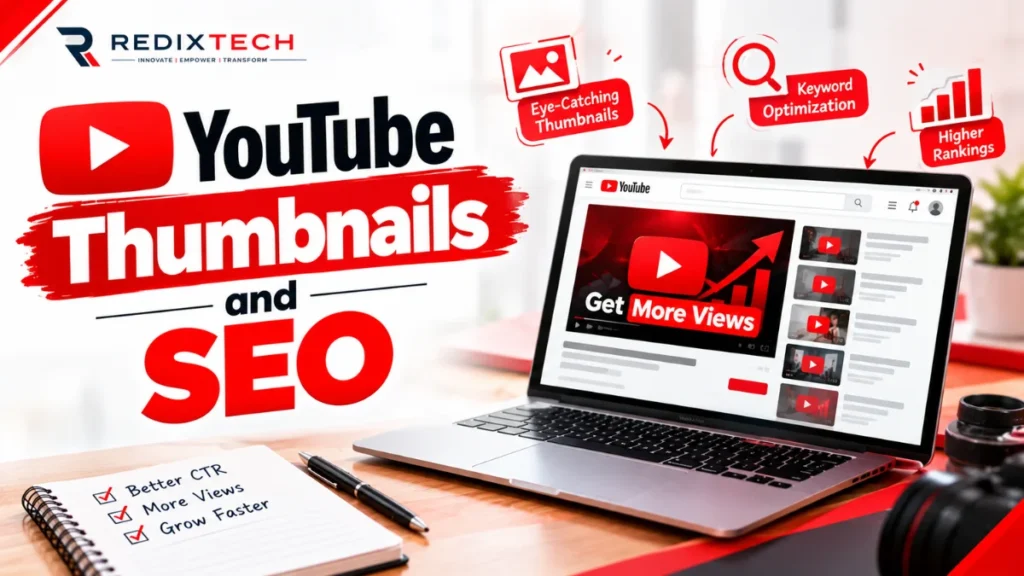
Thumbnails work alongside titles to influence whether someone clicks effective thumbnails generally have a clear visual message, remain readable on a small mobile screen, use strong visual hierarchy (one clear focal point), consistent branding across a channel, good contrast, minimal text, and clear alignment with what the title actually promises.
Click-through rate (CTR) how often people click after seeing your thumbnail and title is a useful metric for analyzing performance, since it reflects how compelling your packaging is. However, a higher CTR does not always mean YouTube will rank a video higher on its own; CTR should be interpreted together with retention and other engagement signals, since a video that gets clicks but immediately loses viewers is unlikely to be favored long-term.
How to Optimize YouTube Video Descriptions
A useful description naturally includes your primary topic, a brief and accurate summary, important supporting information, relevant links, chapters/timestamps where appropriate, a clear call to action, and supporting keywords used naturally rather than repeated mechanically.
A reasonable structure to follow:
- A short introduction stating what the video covers
- A brief summary of the main topic
- What viewers will specifically learn
- Any important links referenced in the video
- Chapters/timestamps, if the video has distinct sections
- Social or contact links
- A clear call to action (subscribe, comment, watch next, etc.)
Avoid repeating the same keyword phrase unnaturally throughout describe the topic thoroughly and let related terms appear naturally, rather than mechanically inserting one exact phrase multiple times.
Do YouTube Tags Still Matter in 2026?
Tags are short, hidden metadata labels attached to a video. Based on current guidance and widely reported creator resources in 2026, YouTube’s systems increasingly rely on more sophisticated content understanding analyzing titles, descriptions, captions, and even spoken audio directly which has reduced how much direct ranking weight tags carry compared to earlier years.
That said, tags still serve a supporting role: they can help YouTube correct for misspellings, recognize synonyms or alternate phrasings, and associate your video with a broader topic category similar in spirit to how hashtags work on other platforms. The practical takeaway is not to depend on tags as a primary SEO strategy; a strong title, accurate description, and satisfying content matter considerably more. Adding a handful of accurate, relevant tags is a reasonable, low-effort supporting step, not a ranking shortcut.
Video Content Is Part of YouTube SEO
Ultimately, the video itself has to deliver on what the title and thumbnail promised. That means genuinely answering the viewer’s question, following a clear structure, providing useful information, maintaining reasonable pacing, opening strongly, avoiding unnecessary filler, and keeping the content accurate.
Optimize the First 30 Seconds
A strong opening quickly introduces the topic, confirms what viewers will actually learn or get from watching, delivers real value early rather than building up to it slowly, and avoids long unnecessary introductions (channel intros, extended greetings, or lengthy sponsor reads before the content itself begins).
There’s no specific retention percentage that guarantees a ranking outcome different video lengths and formats naturally produce different retention curves, so use retention data as a diagnostic tool for your own content rather than chasing one universal number.
Watch Time, Audience Retention and Engagement
| Metric | What It Tells You |
| Watch Time | How much total viewing time your videos generate |
| Average View Duration | How long viewers watch on average |
| Retention | Where in the video viewers stay or drop off |
| CTR | How often impressions result in clicks |
| Subscribers | How many viewers subscribe after watching |
| Returning Viewers | Whether viewers come back for more content |
These metrics work best interpreted together rather than individually a video with high watch time but very low engagement tells a different story than one with modest watch time but strong comments and shares, and neither number alone gives you the full picture of how the video is actually performing.
Use Playlists for Better Content Organization
Playlists help organize related videos into a logical sequence, build topic clusters that establish your channel’s authority on a subject, guide viewers naturally toward related content, create structured learning journeys, and increase the chances that someone keeps watching once they’ve started.
Example for a digital marketing channel a playlist titled “Digital Marketing for Beginners” might include: What Is Digital Marketing?, SEO Basics, Keyword Research, On-Page SEO, Technical SEO, and YouTube SEO each video supporting the next in a clear learning path.
Internal YouTube Linking and Content Clusters
Beyond playlists, creators can connect related videos using end screens, cards where appropriate, playlist placement, description links, pinned comments, and simple verbal references inside the video itself (“I cover that in more detail in this other video”).
Example structure: Video A (YouTube Keyword Research) → Video B (YouTube Title Optimization) → Video C (YouTube Analytics) — each video pointing naturally to the next, creating a connected content ecosystem rather than a set of disconnected uploads.
YouTube Shorts SEO vs Long-Form SEO
| Factor | Shorts | Long-Form |
| Format | Short vertical videos | Longer videos |
| Discovery | Shorts feed + other surfaces | Search, Home, Browse, Suggested |
| Content depth | Usually limited | More detailed |
| Search potential | Topic-dependent | Strong for searchable topics |
| Repurposing | Can support long-form | Can generate Shorts |
Rather than treating these as competing formats, many creators use them together a long-form video can be broken into several Shorts to extend its reach, while a Short that performs well can highlight demand worth covering in more depth in a long-form video. For a deeper comparison, see our related guide, YouTube Shorts vs Long-Form Videos in 2026.
YouTube Analytics for SEO Optimization
YouTube Studio provides the data needed to improve future videos, including impressions, click-through rate, watch time, audience retention, traffic sources, the specific YouTube Search terms bringing viewers to your video, performance from suggested videos, browse features, returning viewers, and subscribers gained per video.
How to Diagnose Performance
A few illustrative diagnostic patterns (possibilities to investigate, not guaranteed explanations):
- High impressions + low CTR → worth reviewing the title and thumbnail, since the video is being shown but not generating clicks
- Good CTR + low retention → worth reviewing the opening and overall content delivery, since viewers click but don’t stay
- Low impressions + strong viewer response from those who do watch → worth investigating topic demand, audience relevance, and how the video is packaged, since the content may be underexposed rather than underperforming
How to Optimize an Existing YouTube Video
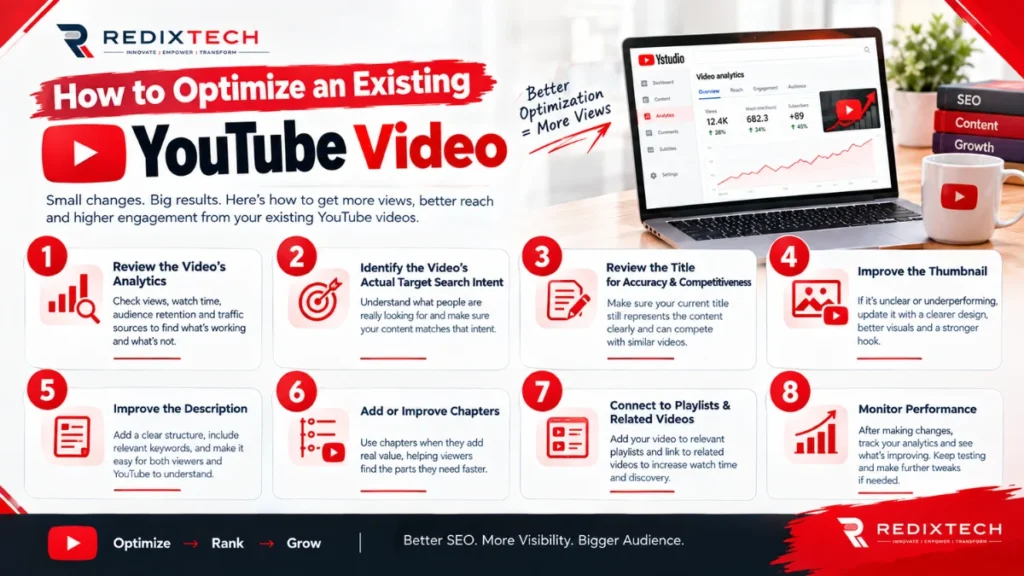
- Step 1: Review the video’s analytics
- Step 2: Identify the video’s actual target search intent
- Step 3: Review whether the current title still represents the content accurately and competitively
- Step 4: Improve the thumbnail if it’s unclear or underperforming
- Step 5: Improve the description’s structure and clarity
- Step 6: Add or improve chapters where genuinely useful
- Step 7: Connect the video to relevant playlists and other related videos
- Step 8: Monitor performance after making changes
Changing a title or thumbnail does not automatically increase views — these changes can improve how well a video communicates its value, but actual results depend on many other factors, including the underlying content and current audience interest in the topic.
Common YouTube SEO Mistakes
- Keyword stuffing titles, descriptions, or tags
- Writing misleading titles that overpromise
- Using clickbait thumbnails or titles that don’t match the actual video
- Copying competitor titles directly instead of writing an original one
- Ignoring the actual search intent behind a topic
- Using irrelevant trending keywords unrelated to the video’s content
- Publishing unclear, low-contrast, or cluttered thumbnails
- Opening videos with long, unnecessary introductions
- Ignoring YouTube Analytics entirely after publishing
- Creating videos purely around keywords rather than genuine viewer value
- Uploading inconsistent, low-effort content without a clear content strategy
- Buying views, subscribers, or engagement which violates YouTube’s policies and undermines genuine growth
- Relying on outdated YouTube SEO advice from several years ago without verifying it’s still accurate
- Ignoring how content appears and performs for mobile viewers
Can AI Be Used for YouTube SEO?
AI tools can reasonably assist with brainstorming topic ideas, clustering related keywords, drafting outlines, generating title variations to consider, producing first-draft descriptions, planning content calendars, and organizing competitor research findings.
Even so, creators should verify any factual claims AI produces, add genuine original insight and perspective, fact-check details before publishing, avoid copying phrasing too closely from any single source, and avoid mass-producing low-quality, formulaic content just because AI makes it fast to generate. YouTube has publicly emphasized valuing original, human-driven content, and using AI as a starting point doesn’t remove the need for human editing and quality control over what’s ultimately published.
YouTube SEO Workflow for Beginners
1. Find a topic
2. Research keywords
3. Understand the search intent behind the topic
4. Analyze competing videos already covering it
5. Create a clearer or more complete content outline than what exists
6. Write an accurate, specific title
7. Create a strong, clear thumbnail
8. Produce the video itself
9. Optimize the description and supporting elements
10. Publish
11. Analyze performance in YouTube Studio
12. Apply what you learn to improve future videos
YouTube SEO Checklist
- Topic has clear audience relevance
- Search intent identified
- Keyword researched
- Competitor videos analyzed
- Title accurately represents the video
- Thumbnail is clear and readable on mobile
- Description is genuinely useful, not just keyword-packed
- Relevant chapters added where appropriate
- Video delivers on the title’s promise
- Related videos/playlists connected
- Analytics reviewed after publishing
- Improvements documented for next time
Frequently Asked Questions
What is YouTube SEO?
YouTube SEO is the practice of optimizing videos through titles, descriptions, thumbnails, and content quality so they’re more discoverable through YouTube Search and YouTube’s recommendation systems.
How do I rank YouTube videos in search?
Focus on matching real search intent, writing clear and accurate titles and descriptions, creating a satisfying viewer experience, and reviewing analytics to improve over time no single tactic guarantees a specific ranking.
Are YouTube tags still important in 2026?
Tags carry considerably less direct ranking weight than in earlier years, since YouTube’s systems now understand video content through titles, descriptions, and captions directly tags still play a minor supporting role for misspellings and topic association, but shouldn’t be treated as a primary strategy.
How many keywords should I use in a YouTube video?
There’s no fixed ideal number the goal is natural, accurate topic coverage in your title, description, and content, not hitting a specific keyword count or density.
Does watch time affect YouTube SEO?
Yes, watch time and audience retention are widely understood to be significant signals, since they reflect whether viewers are actually engaged with and satisfied by a video though they work alongside other signals, not in isolation.
Are thumbnails part of YouTube SEO?
Yes, thumbnails directly influence click-through rate, which is one input among several that affects how a video performs a clear, accurate thumbnail that matches the title tends to support better overall performance.
How long does YouTube SEO take to show results?
Results vary considerably by niche, content quality, consistency, and competition there’s no fixed timeline, and meaningful, sustainable growth is typically the result of consistent effort over months rather than a single optimized upload.
Competitor Research Summary
Before writing, current 2026 YouTube SEO articles were reviewed to identify content gaps this guide aims to fill:
| Competitor | Topic Coverage | Strengths | Content Gaps |
| W3era YouTube SEO Guide | Ranking factors, titles, descriptions, schema | Detailed character-count and semantic-cluster advice | No search-vs-recommendation distinction; no beginner workflow |
| SEO Sherpa YouTube SEO Guide | Ranking factors overview | Clear metadata/watch time/engagement breakdown | No existing-video optimization process; no AI-use section |
| WsCube Tech YouTube SEO Guide | General ranking factors, checklist | Beginner-friendly tone | Presents some claims too definitively; no CTR+retention diagnostic framework |
| Workshop Digital YouTube SEO Guide | Algorithm signals, tags, original content | Balanced, cites official tag guidance accurately | Limited practical keyword research steps; no Shorts comparison |
| Backlinko-style ranking guides | Tags, watch time, engagement | Well-known, detailed | Leans on older tag-heavy advice; light on 2026 NLP/AI content understanding |
| OutlierKit YouTube SEO Strategy | Titles, descriptions, tags, templates | Practical character-limit templates | Tool-promotional framing; no responsible-AI-use discussion |
Conclusion
The clearest gaps across existing content were a lack of clear separation between Search and Recommendations, overconfident claims about exact ranking factors, limited guidance on optimizing existing (already-published) videos, no responsible-AI-use discussion, and little practical connection between CTR and retention as a combined diagnostic tool gaps this article specifically addresses.