Discover the top 10 Meta Ads trends 2026 shaping Facebook & Instagram advertising. From AI-powered campaigns to Reels ads & Advantage+ — stay ahead of every algorithm shift. Read now.
Meta Ads Trends 2026 are transforming how businesses reach and engage audiences on Facebook and Instagram through personalized messaging, AI-powered discovery, smarter targeting, and advanced advertising technology. As Meta strengthens its position in digital advertising, AI-driven recommendations and automation are becoming increasingly important for advertisers.
What are Meta Ads:
Meta ads denote the promotional tools provided by Meta Platforms Inc. This encompasses advertising opportunities on all Meta platforms, including Facebook, Instagram, Messenger, Threads, and, to a degree, WhatsApp. These advertisements enable you to focus on particular audiences by utilizing various factors such as demographics, interests, behaviors, and even segments from your own CRM. Meta Ads Trends in 2026 focus not only on audience reach on Facebook and Instagram but also on engaging the appropriate audience at the optimal moment with a tailored message.
Why are Meta Ads are changing in 2026:
Regardless of the rising competition, Meta maintains its leadership position, bolstered by its extensive user base and sophisticated advertising framework. With billions of active participants, through facebook ads trends and Instagram ads trends companies can engage with a variety of audiences effectively.
By 2026, Meta Ads supremacy has not only endured but intensified. For the first time, the company’s yearly advertising earnings are anticipated to exceed those of Google, reaching around $243 billion. This leadership is fueled by a significant transition from search-oriented intent to AI-enhanced discovery. In 2026, Meta Ads are propelled by AI automation, Meta Ads AI focus on creative strategies, and short-form video content. Meta advertising Trends are increasingly emphasizing captivating visuals over conventional targeting methods. Concurrently, privacy-conscious tracking guarantees that campaigns remain efficient while upholding user privacy. These shifts contribute to making AI advertising more effective and outcome-oriented.
10 Meta Ads Trends to Watch in 2026:
These are the top Meta Ads trends in 2026:
- AI Powered Meta Ads: Ai powered Meta Ads utilizes generative AI, machine learning, and analytical data to assist advertisers in enhancing the efficacy of their campaigns while minimizing the need for manual configuration. Integrated within the Advantage+ Ads manager, this framework accelerates the processes of developing, evaluating, and refining advertisements across Meta’s various platforms.
- Advantage + Campaign Automation: Meta has effectively moved from a manual system to one that is managed by artificial intelligence. The Advantage+ suite now oversees bidding, placements, and audience targeting with greater effectiveness compared to human media buyers.
- AI Generated and AI Enhanced Ad: AI-generated ads refer to those where artificial intelligence substantially develops or alters main creative components such as the script, visuals, audio, and editing rather than merely enhancing aspects like targeting or bidding.
- Creatives: Since users are browsing through feeds instead of actively searching, your content needs to immediately capture their attention. High-quality creative contributes to more than fifty percent of a campaign’s overall effectiveness, providing Meta’s algorithms with essential engagement indicators.
- Reels: Reels ads on Instagram and Facebook are immersive, vertical video promotions that display in full screen as viewers navigate through the Reels section, Explore page, and their home feed. These ads resemble standard Reels content, featuring audio, effects, and engagement elements, yet they come with a “Sponsored” tag and a call-to-action button.
- Creator and UGC Based Targeting: UGC concentrates on developing genuine and relatable material for brands to incorporate into their promotional strategies. This type of creator might engage in producing content that connects with consumers, showcasing personal product experiences, ensuring consistency with brand messaging, trying out various styles to determine what appeals to the target audience, and providing top-notch visuals.
- Click to Message and Conversational Advertising: Advertisements that feature a click-to-message function allow you to connect with targeted audiences, guiding individuals who click on your ad straight into discussions with your business via Messenger, Instagram, or WhatsApp.
- Better Conversion Tracking and First Party Data: First-party data serves as the essential basis for marketing, deriving directly from customer actions and facilitating improved forecasting, targeting, and customer retention. Its worth escalates when utilized across various channels, including email, push notifications, and messaging, transforming insights into financial gains.
- Personalized and dynamic Ad Experiences:
- Personalized advertising, which was previously referred to as interest-based advertising, leverages customer insights to enhance ad relevancy. As online advertising has surged in popularity over the past few years, personalized advertising has emerged as an effective means to boost the relevance of ads for consumers, simultaneously driving higher ROI for advertisers.
- Broad Audience Targeting: Broad Targeting enables an increase in your audience reach and enhances brand visibility. Utilizing Broad Targeting, you can access a broad demographic in your campaign’s country, effectively connecting with a larger group of potential individuals.
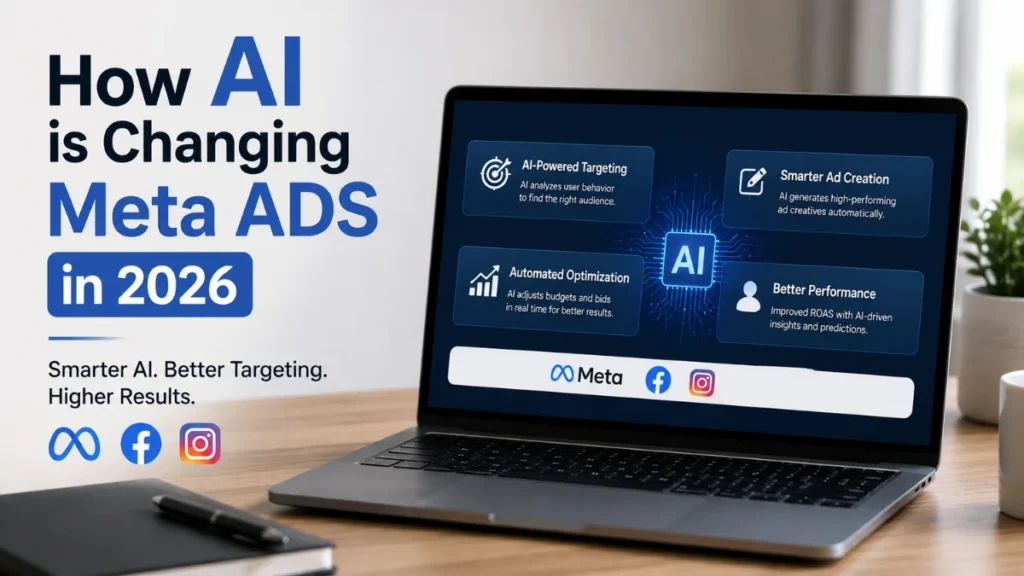
How AI is Changing Meta ADS in 2026
Meta AI ads actively pursuing AI-driven automation and personalization. Its new ad retrieval system has significantly changed how advertisements are matched with users. Additionally, Meta has been expanding its Advantage+ AI tool suite, which includes features for creative development, targeting, and budget management. The companies aim to streamline media buying by simplifying processes, maintaining broader audiences, providing advertisers with reduced control and fewer targeting options, and suggesting fewer ad sets for each campaign. Much of the justification for Meta’s substantial investment in generative AI is based on the expectation of improved ad performance, which is a recurring topic in the company’s earnings discussions. While marketers have reported enhancements from some of Meta’s automation tools, they acknowledged that these tools are not without limitations.
Why Creative is Becoming more important in 2026:
In the current competitive landscape, the well-known saying “content is king” holds greater significance than ever. The impact of facebook ads strategy and Instagram advertising trends are crucial for achieving success in marketing. User-generated content (UGC) advertisements allow you to rise above the clutter and engage with your target audience. They serve as a form of social validation, showcasing genuine experiences that enable audiences to envision how a product integrates into their daily lives, thereby simplifying their purchasing choices. Content that mirrors authentic behaviors and settings tends to draw more attention than highly polished brand advertisements. Effective hooks and relatable presentation boost user engagement and click-through rates, resulting in meta ads optimization and improved conversion rates. Reels Ads present an attractive option for companies aiming to strengthen their digital footprint and foster interaction.
Meta Ads Trends 2026 for Facebook vs Instagram
Facebook Feed: Options of 1:1 (1080×1080) or 4:5 are available. This placement remains stable and offers high value by default.
- Instagram Feed: Matches the size of the Facebook Feed; however, shares have decreased by 26% since the Explore Feed was discontinued and integrated into Reels.
- Instagram Reels: Designed for 9:16 (1080×1920) full-screen viewing. This format is currently the fastest-growing segment, accounting for 33% of Instagram impressions, making it a primary focus.
- Stories (Facebook and Instagram): Also formatted in 9:16, identical to Reels, allowing a single asset to function for both platforms.
- Messenger: Utilizes the same 1:1 asset as the Feed, effectively serving for direct messaging and lead generation.
- Others: For Marketplace/Right Column, the dimension is 1:1; In-stream formats are 16:9; and Explore Home (grid) retains the 1:1 size.
How to create a Meta Ads Strategy in 2026
Define campaign objective: No matter if you aim to boost your product sales, enhance your website traffic, or establish new business connections,define the campaign objective to achieve your target.
Identify target customers: Organize your target audience into different tiers based on their levels of intent. Individuals who show a clear intent to buy often require messages that minimize barriers (such as tackling objections, providing guarantees, or reminding them of their abandoned carts).For users who view product pages and add items to their carts without completing the purchase, employing creatives that emphasize social proof may benefit them, along with a gentle incentive to encourage their decision. As for general site visitors and content consumers, these individuals require nurturing content that fosters brand recognition and product knowledge prior to making a conversion request.
Creative concepts: Organize your creative experiments in a matrix format. Typical variables to examine include the type of hook (such as text overlay, auditory hook, or visual hook), the duration of the video, the choice between static images and video content, styles of testimonials (like written versus video, or amateur versus professionally produced).
AD formats: By 2026, Meta’s advertising ecosystem includes Facebook, Instagram, Messenger, Threads, WhatsApp, and the Audience Network. Each platform accommodates various formats, with each format tailored to serve distinct purposes. Additionally, Meta’s algorithm processes and delivers each format uniquely, depending on the specific objectives, placements, and creative cues it detects.
Appropriate Automation: Implement campaigns that simplify the creation process, provide personalized advertisements, and leverage our cutting-edge technology to achieve superior outcomes
Launch Campaigns and monitor performance: After launching the campaign make sure that it offer meaningful analysis of how users respond to your facebook advertisements. Examine the definitions of the metrics you have chosen, particularly the Click-Through Rate (CTR), which could incorporate supplementary information such as social interaction.
Creative Test: In a creative test, it is possible to evaluate as many as seven variations of creative content, with distribution focused on new test advertisements. This testing is integrated within a current campaign, ensuring that successful ads remain active even after the testing phase, while insights gained from the delivery system are preserved. There is no requirement to combine them into a different campaign, as doing so would result in a loss of accumulated insights.
Scale what works: There are two essential strategies for scaling Meta ads. First is Augmenting the budget for campaigns and ad sets that are currently successful and the second is Broadening the reach by exploring new audiences, creative materials, and campaign configurations while maintaining existing successful elements.
Meta Ads for Small Businesses:
Small businesses gain multiple advantages from Meta Ads. They serve as an economical approach to enhance brand exposure and draw in prospective clients. Furthermore, Meta Ads for small businesses come equipped with comprehensive analytics, enabling companies to monitor their campaign effectiveness and implement data-informed modifications. This information aids small businesses in optimizing their advertising expenditures, thereby boosting the likelihood of realizing a favorable return on investment and this is the best Meta ads strategy for small businesses.
Meta Ads Metrics you should Track
CPC measures the amount you invest for each click your advertisement receives. A reduced CPC suggests your campaign is more economically efficient.
Click-Through Rate (CTR) quantifies the proportion of viewers who engaged with your ad by clicking on it. This metric is a strong reflection of how attractive your messaging and visuals are.
Cost per Result (CPR) reflects the expense associated with each desired action achieved. A decline in this figure while maintaining strong results indicates effective optimization.
Return on Ad Spend (ROAS) assesses the revenue generated for each dollar spent on advertising. A higher ROAS signifies a campaign that is yielding greater profits.
Conversion Rate (CVR) indicates the fraction of users who accomplished your goal after engaging with your ad. This measure is vital for evaluating the efficiency of your sales funnel.
Frequency metrics highlight exposure and visibility Facebook and Instagram reels, making them essential for assessing awareness and branding initiatives. Frequency is determined by dividing total impressions by reach.
When the intention of your campaign is to achieve measurable outcomes like sales or leads, conversion metrics become the key performance indicators.
Impressions denote the overall number of displays of your ad.
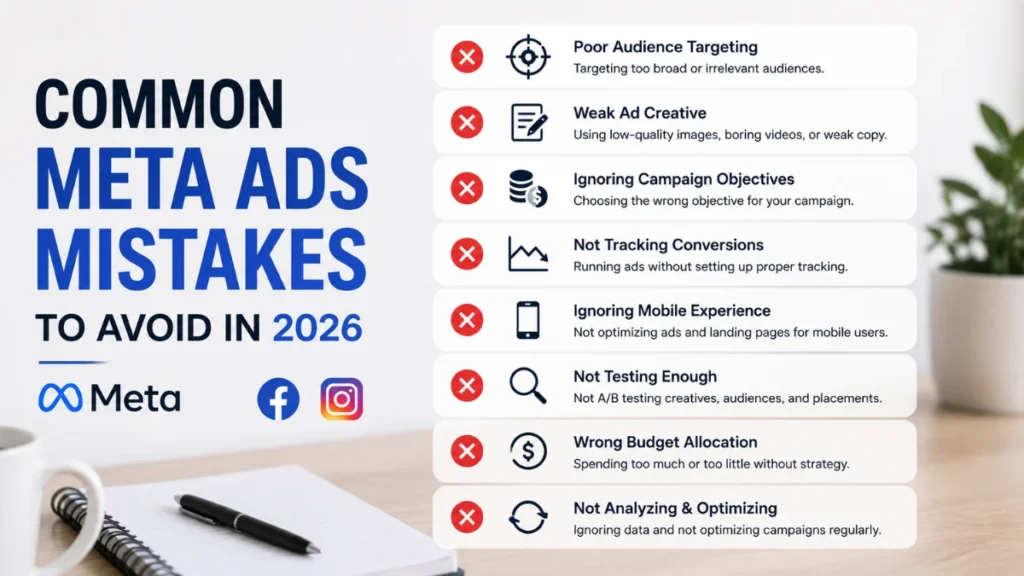
Common Meta Ads mistakes to avoid in 2026:
There are many Meta Ads mistakes that we should avoid for better traffic on Facebook and Instagram. The most effective newcomers utilize organized processes that identify mistakes before they escalate into costly issues. Numerous companies concentrate solely on interest targeting while overlooking their most important audience: individuals who visit their websites, email list recipients, and previous clients. Errors related to creativity and budgeting frequently remain undetected for extended periods, as performance declines slowly. This includes not having an engaging hook within the initial three seconds, designing exclusively for sound-on viewing, or making videos that are overly lengthy for mobile users.
FAQs:
- What is Meta Ads optimizing in 2026?
Meta prioritizes real engagement signals such as interaction, viewing behavior, and relevance.
- What is the optimal format for Meta advertisements?
There isn’t a definitive “optimal” format; it varies based on your objectives and target demographic.
- What characteristics make a Meta ad exceptional?
The most effective Meta advertisements integrate attractive visuals, unambiguous messaging, and persuasive calls-to-action.
- Which Meta ad formats are anticipated to excel in 2026?
The leading Meta advertisement formats for 2026 include short-form video (Reels), carousel advertisements, and dynamic product ads (DPA). Video ads that are less than 15 seconds long consistently yield the greatest engagement.
- How successful are AI-generated Meta advertisements?
Meta ads generated by AI, such as those produced using Meta GEM technology, are showing significant effectiveness when executed correctly.
Conclusion:
The trends in Meta ads for 2026 indicate a landscape filled with both promising opportunities and considerable challenges. The transition towards AI-driven automation is transforming the strategies that businesses utilize for advertising on Facebook and Instagram. For companies, these developments offer the potential for enhanced outcomes while reducing the need for manual input. This automation is designed not to substitute human decision-making but to enhance it, allowing marketers to shift their focus from repetitive tactical tasks to areas such as strategic planning, creativity, and a deeper understanding of customers.