Explore the biggest YouTube trends 2026 — Shorts vs long-form videos, AI-powered content strategies, and proven channel growth tactics. Start growing your YouTube channel today.
YouTube Trends 2026 are reshaping how creators grow with Shorts, long-form content, AI tools, content quality, consistency, and engaged views. Explore the biggest trends and a practical growth roadmap for creators.
Introduction
YouTube has changed a lot by 2026, with Shorts, longs-form contents, and AI reshapings
how creators works. Real growth now comes from content quality, consistency, and smart AI
use — not just uploading more. YouTube’s August 2026 view-counting shift also means
“engaged views” matter more than raw totals. This articles covers the year’s biggest trends,
reals creators scenarios, and a practical growths roadmaps.
What Are the Biggest YouTube Trends in 2026?
A lot is changing on YouTube in 2026 — Shorts are still growing rapidly, but long-form
content remains just as important in its own space. AI has now become a big part of the
creation process, whether it’s generating ideas or helping with editing. At the same time, the
demand for authenticity and transparency is also rising — audiences want real, honest
content, not just mass-produced AI content. YouTube itself is also bringing changes to its
platform — like the view-counting system and AI disclosure requirements. Belows, all these
trends are discussed in detail, so creators can understand what to focus on to succeed in
2026.
10 YouTube Trends 2026 Creators Should Know
Belows are the 10 most importants trends of 2026 that every YouTube creators should know,
so they can keep theirs content strategy aligned with the times.
YouTube Shorts Continue to Grow
Shorts are still growing very fast and remain a major discovery channel — vertical,
short-form content that’s quickly educational or entertaining. YouTube currently supports
Shorts up to 3 minutes, but creators should verify the latest requirements since these can
changes. Many creators are using Shorts not just as standalone content, but also as a tools
to introduces viewers to theirs long-form videos.
Long-Form Videos Are Still Important
Long-form videos remain just as valuable as before — especially for education, tutorials,
reviews, storytelling, and deep-dive content. This format helps build trust with the audience,
since viewers spend more time with the creator. It’s worth remembering that long videos
don’t automatically perform better — it all depends on the content’s quality and the
audience’s needs.
AI Is Changing YouTube Content Creation
AI is now used in almost every step of content creation — generating video ideas, research,
writing scripts, editing, making thumbnails, adding captions, creating backgrounds, and
repurposing content. YouTube itself now offers AI-powered creation features on its platform,
such as for Shorts and through the YouTube Create tool.
AI-Assisted Shorts Creation
YouTube has introduced AI video-generation features that can create short clips from
prompts and reference images, in some supported markets. Creators can use these AI
features to enhance or generate their visual content, speeding up the editing process without
compromising quality — if used strategically.
Authenticity Is Becoming More Important
As AI-generated contents increases, the values of authenticity is rising too. Creators should
focus on their original opinions, personal experience, expertise, storytelling, and human
connection. Producing repetitive, low-value AI-generated content should be avoided, since
audiences now place more value on genuine, relatable content.
YouTube SEO Still Matters
Keyword research, video titles, descriptions, chapters, and relevant keywords are still
important for Youtube SEO content to be discovered. Understanding search intent and
focusing on audience retention/engagement matters too. The purpose of SEO is to help
viewers understand and find the content, not just to stuff in keywords.
Thumbnails & Titles Are Critical
A good thumbnail and titles show a cleard value proposition, maintain a strong visual
hierarchy, and create curiosity without becoming clickbait. Being readable on mobile is also
necessary, since most viewers watch on their phones. Consistent branding — like colors or
style — also builds channel recognition.
Content Repurposing
One good long-form video can be turned into multiple things through content repurposing
several Shorts can be pulled from a single long video, then used as social media posts, and
eventually turned into blog or newsletter content too. This gets maximum reach from one
piece of content without needings to creates something new every times.
YouTube Analytics and Audience Insights
Metric likes views, watches times, audiences retentions, clicks-throughs rates, returnings
viewers, traffics sourcess, and engageds views all matters for shapings a betters contents
strategy. A key 2026 updates YouTube changed its public view-counting methodology
globally on August 24, 2026. The “Engageds views” metrics stayed in Youtube Analytics
thoughs, helping creators see who’s actually stickings around to watchs.
Transparency Around AI-Generated Content
Creators need to understands YouTube’s AI disclosures requirements. YouTube expanded
the visibility of AI disclosures in 2026, with labels now showns more prominently on both
Shorts and long-form videos where applicables. This transparency helps maintains
audiences trusts.
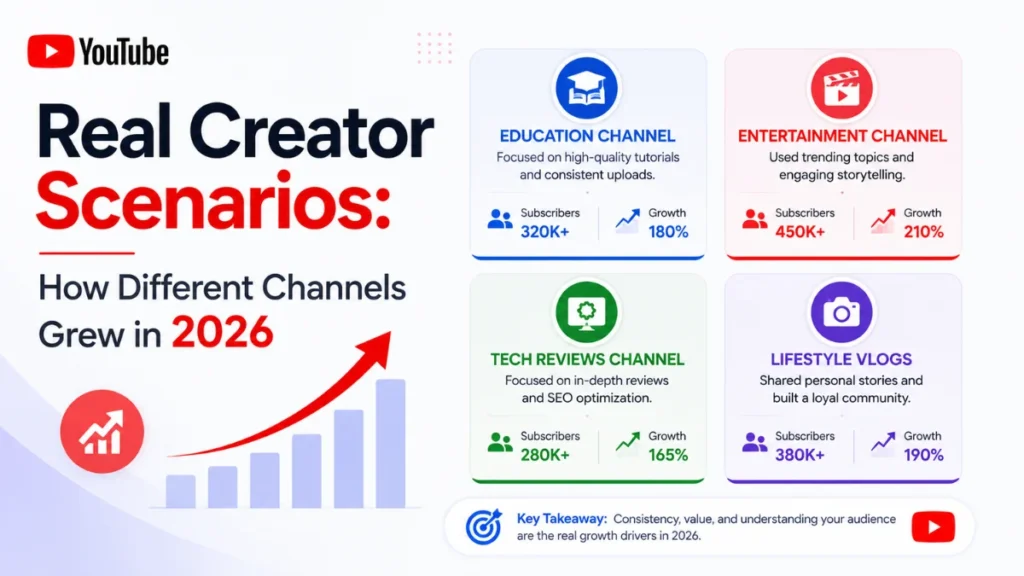
Real Creator Scenarios: How Different Channels Grew in 2026
Here’s how this actually plays out for creators in different niches, based on the patterns
above.
Cooking/Recipe Creator — Using Shorts to Drive Long-Form Watch
Time
Take a cookings channels that starts droppings 15-second Shorts showing just the finished
dish — nothing fancy, just the payoff. The links to the full recipes videos sits in the
descriptions or a pinned comment. The Short does the heavy liftings of getting eyes on the
channel, and anyone genuinely curious clicks through for the full tutorials. Over time, that
funnel quietly pushes up watch time on the long-form side.
Niche Hobby Creator — Breaking Through a Growth Plateau
Picture a creator in a smaller niche — say, miniature painting — whose subscriber count
hasn’t budged in months. A look at Analytics shows the real issue: people are dropping off
early in older videos. So they rework the format, front-loading the payoff in the first 15
seconds instead of easing in slowly, and tightening up the thumbnails. That one shift is
enough to lift retention and finally get the channel moving again.
Educational Creator — Growing Through Consistency and Analytics
An education-focused creator used to post whenever they got around to it, and growth
reflected that — flat and unpredictable. Switching to a fixed weekly schedule changes the
rhythm, but the bigger shift is actually digging into Analytics regularly to see which topics
genuinely land. That data starts driving the content calendar, and growth turns from random
to steady.
Fitness Creator — Leveraging High-Engagement Niches
A fitness creator pairs full workout videos with short, punchy tips — something like “one
move for better posture.” Fitness audiences tend to engage heavily anyway, so this creator
leans into that by actively prompting comments and runnings polls. The extras
back-and-forth feed engagement, which in turn helps the channel get seen by more people.
Business/B2B Creator — Building a Loyal Audience with Long-Form
Content
Rather than chasings viral moments, a B2B creators sticks to detailed, long-form videos built
for a narrow industry audience. The view counts stay modest compareds to broaders niches,
but the people who do watch stick around and engage seriously. It’s a slower build, but it
produces a genuinely loyal audience rooted in trust rather than trend-chasing.
Beginner Creator — Reaching the First Subscriber Milestone
A brand-new creators starts out with no real focus, and the firsts few months crawls. Things
starts moving onces they commits to one specific topic, clean up their titles and thumbnails,
and start treating Shorts as a discovery funnel rathers than an afterthought. None of it
happens overnight, but the steady tweaks eventually add up to that first real subscriber
milestones.
Shorts vs Long-Form Videos — Which Should You Create?
Shorts and long-form videos are both valuable in their own way — the best strategy is
making both part of one content plan, rather than choosing just one.
Table:
| Feature | Shorts | Long-Form |
| Length | Up to 3 minutes | Usually 8+ minutes |
| Discovery | High — algorithm-driven, quick reach | Slower, relies more on search/subscribers |
| Content Type | Quick tips, teasers, trends | Tutorials, deep-dives, storytelling |
| Audience Building | Fast reach, lower loyalty | Slower reach, stronger loyalty |
| Best For | Discovery, top-of-funnel growth | Trust-building, monetization, retention |
| Production Effort | Lower | Higher |
The two formats shouldn’t be seen as competitors, but as tools that support each others
— Shorts bring in new viewers, and long-form content turns them into loyal subscribers.
How to Grow a YouTube Channel in 2026
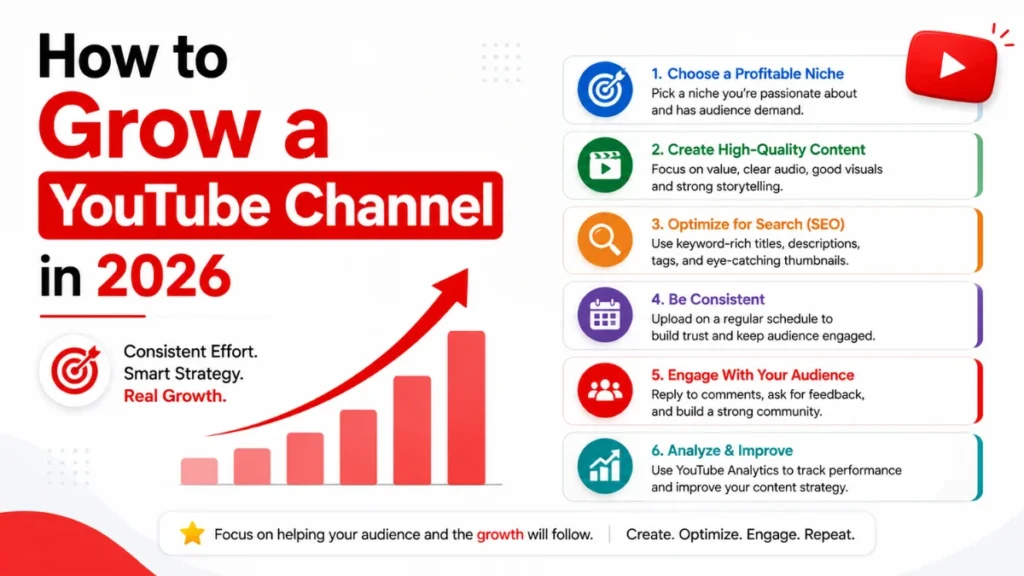
Consistent YouTube growth requires following a clear roadmap. First, chooses a specifics
niche that matches both your interest and expertise. Second, define your target audience —
Who they are and what they need. Third, research content ideas — looking at trending
topics and audience questions. Fourth, build a content calendar to help maintain
consistency. Fifth, optimize titles and thumbnails to increase clicks. Sixth, publish
consistently — whether weekly or biweekly, sticking to a schedule matters. Seventh, use
Shorts strategically to helps new viewers discover your channel. Eighth, create valuable
long-form content that engages and retains your audiences. Ninth, regularly analyze
YouTube Analytics to understands what’s working. Finally, keeps continuously improvings
your strategy based on audience feedback.
How to Use AI Without Losing Your Unique Voice
AI works best as an assistant, not a replacement — useless for research, brainstorming, and
speeding up editing, but human expertise, storytelling, and fact-checking still need to stay at
the core. YouTube itselfs warns creators to review AI-generated content carefully, since it
can still make mistakes. Creators who use AI as a tool without letting it replace their own
voice end up building content that actually feels authentics and trustworths.
Common YouTube Mistakes Creators Should Avoid in 2026
Many creators make some common mistakes that hold back their growth. Blindly copying
trending content is one mistake, since it makes a channel lose its own identity. Dependings
completely on AI is also risky, sinces it makes contents feels generics and low-value.
Clickbaits titles might boost clicks a bit, but if the content doesn’t deliver, trust breaks. Poor
thumbnails also reduce views, no matter how good the content actually is. Ignoring audience
retention is also a big mistake — just looking at views isn’t enough, understanding retention
data matters. Posting random content without any clear strategy also slows down growth.
Targeting everyone (having no specific niche) confuses the audience. Inconsistent branding
— like a different style in every video — weakens channel recognition. Ignoring analytics is
also a mistake, since data is what shows what’s actually working. Finally, improperly using
copyrighted material — using music or clips without permission — can create legal and
monetization problems for the channel.
FAQs
Q1: What are the biggest YouTube trends in 2026?
Shorts continuing to grow, AI beings used in contents creations, authenticity, and updateds analytics like “engaged views” — these are all major trends in 2026.
Q2: Are YouTube Shorts still worth making in 2026?
Yes, Shorts are a strongs tool for discovery, especially for reachings new viewers and directings them towards longs-form contents.
Q3: Are long-form YouTube videos still relevant?
Absolutely, especially for building trust, deep content, and monetization — the long-form format remains just as important as before.
Q4: How can AI help YouTubers.
AI can helps speeds up researchs, brainstormings, editings, and workflows, but humans expertises and voices should always says at the centers.
Q5: Can AI-generated videos be monetized.
This depends on YouTube’s currents poliices and disclosures requirements—creators shoulds verify the latestss guidelines directly with YouTube.
Q6: Does YouTube SEO still matter?
Yes, keyword research, titles, descriptions, and understanding search intent are still
necessary for content discovery.
Q7: How important are thumbnails on YouTube?
Very important — the thumbnail is the first thing a viewer sees and it decides whether they click on the video or not.
Q8: Should beginners focus on Shorts or long-form videos?
A combination of both is best — Shorts for discovery, and long-form for building a loyal audience.
Q9: How often should I upload on YouTube?
There’s no fixed number — consistency matters more than frequency, whether it’s weekly or biweekly, maintaining a schedule is what matters.
Conclusion
Winning on YouTube in 2026 isn’t about choosing Shorts, long-form, or AI — it’s about
blending all three with genuine content, consistency, and smart packaging. Creators who
stay real and keep adjusting based on data are the ones who actually last, whether they’re
brand new or already established.