Introduction
If you want to start your career in digital marketing, SEO, content writing, web development, graphic design, AI, or e-commerce, python, data analytics and many more, you may be skeptical about taking an online course, pursue an internship, or learn individualistically using free resources. Although each path has a distinct function, there are three that will assist students and novices in emerging practical skills. An online course provide students a structured planner and guidance to develop skills, an internship exposes you to real-world work tasks. On the other hand, self-study provides flexibility and independence. The best opportunity depends on your goals, financial resources, deadlines, choices regarding learning platforms and current skills; there isn’t a single best option. This article breaks down the difference of internship vs online course vs self learning, which option provides more practical learning that will help you in future.
Internship vs Online Course vs Self-Learning: Quick Comparison
The discussion surrounding the pros and cons of internship vs online courses vs self learning is intricate, as both methods of teaching present distinct advantages and disadvantages. Although online learning offers convenience and ease of access, conventional classroom learning encourages personal interactions and active participation.
| Factor | Internship | Online Course | Self-Learning |
| Learning Structure | Guided, workplace-based | Structured prospectus | Amorphous, learner-driven |
| Practical Experience | High chances of practical experience | Modest (guided exercises) | Depends on learner’s creativity |
| Flexibility | Low to moderate, sometimes you have to follow the timelines. | Moderate to high (sometimes self paced) | Very high |
| Mentorship | Frequently available | Limited/instructor-led | Usually none |
| Portfolio Building | Real project exposure | Course-based projects | Personal/practice projects |
| Feedback | Direct from administrators | Instructor or peer feedback | Self-assessment or community |
| Cost | Free, paid, or unpaid | Free to premium | Mostly free, some paid tools |
| Networking | Strong (professional contacts) | Limited | Community-dependent |
| Job Readiness | Strong exposure to workflows | Builds foundational skills | Builds independent problem-solving |
| Best For | Organized exposure seekers | Beginners needing supervision | Highly self-motivated beginners who wants to learn and develop skills |
Understanding Each Learning Path
What Is an Internship?
An internship is a method of gaining practical experience that combines theoretical knowledge acquired in the classroom with practical skills and application within a professional work environment (which can be in-person, remote, or hybrid). These internships offer students the chance to acquire meaningful hands-on experience, build professional networks, investigate various career paths, and establish connections within industry sectors. Furthermore, internships act as an significant recruitment tool for employers, allowing them to mentor and assess prospective candidates.
What Is an Online Course?
An online course offers a structured approach to learning through various components such as video lessons, tasks, quizzes, templates, certifications, and guidance from instructors. The primary advantage of these courses lies in their organized format, which includes a well-defined curriculum, access to expert information, flexible timing, and often low-cost or free entry, allowing students to progress at their own pace.
Nonetheless, online courses come with certain drawbacks. Learners may adopt a submissive method if they simply watch videos without putting the ideas into practice. Additionally, the feedback provided can be less comprehensive than what might be received in a traditional workplace, and completing a course does not necessarily equate to gaining practical experience. A certificate by itself may not always effectively showcase practical skills to potential employers.
What Is Self-Learning?
Self learning refers to the independent attainment of digital capabilities through accessible resources like certification, YouTube videos, blog posts, online forums, hands-on projects, literature, and AI applications. Its primary advantages include noteworthy flexibility, affordability, tailored educational experiences, and the enhancement of self-sufficient problem-solving skills. However, the drawback of self-directed learning is its absence of a defined framework. Sustaining consistency can be challenging in the absence of deadlines or accountability. Moreover, feelings of information overload are prevalent, opportunities for mentorship are scarce, and novices may struggle to recognise their skill deficiencies without external input.
Detailed Comparison
Which Option Provides More Practical Experience?
Internships theoretically provide the most practical, hands-on experience, since beginners work on real or simulated tasks, projects, and expert workflows under some level of administration. Online courses usually provide guided exercises and projects, but the depth depends heavily on course quality. Self-learning allows learners to build unlimited projects on their own, but the outcome depends entirely on the learner’s discipline and initiative without external structure, practical experience can be inconsistent.
Which Is Better for Building a Portfolio?
All three paths can contribute to a strong portfolio, but in diverse ways. Projects and work accomplished during an internship are often subject to company privacy, so learners may not always be able to showcase that work publicly. Online courses typically provide assignments and capstone projects that can be added to a portfolio. Self-learning allows learners to build personal projects, open-source contributions, case studies, and practice projects but it is important that learners accurately label this work and never present sample or practice projects as paid client work.
Which Option Is Best for Learning Digital Skills?
This is based on the learner’s characteristics. Newcomers who require structure typically gain the most from online courses. Learners who like independence and enjoy self-exploration might outshine through self-learning. Individuals who require guidance and responsibility could gain more from internships. Those with restricted finances often opt for self-learning or free/low-cost options, while students having jobs may favor the flexibility of online courses or self-paced learning. In frequent instances, a mix of approaches proves more operative than depending solely on one.
Internship vs Online Course vs Self-Learning for Job Readiness
Job readiness relies on various factors: practical abilities, communication skills, a portfolio, interview preparation, problem-solving, teamwork, and knowledge of professional processes. Internships often enhance workplace and collaborative abilities. Online courses contribute to systematic, foundational skill acquisition. Self-directed learning fosters independent problem-solving and flexibility. It’s important to emphasize that following any one path does not ensure job readiness typically arises from a blend of skills, hands-on experience, and a showcase portfolio.
Which Option Is Better for Freelancing?
Achieving success in freelancing usually necessitates a combination of technical expertise and the capability to manage projects and clients on one’s own. Internships can enhance professional communication and provide insight into project workflows. Online courses offer the necessary skill development and structured educational grounding that freelancers require. Self-directed learning fosters independent problem-solving and the habit of continuous learning that freelancers depend on regularly. Many successful freelancers integrate technical training with practical experience in managing their own projects and client relationships.
How AI Is Changing Internships, Online Courses & Self-Learning
Artificial intelligence is reshaping how people learn digital skills across all three paths. AI tools can now assist with research, explaining difficult concepts, generating practice exercises, simulating client briefs, giving feedback on work, brainstorming ideas, and automating repetitive parts of a workflow. This applies whether you are completing an internship task, working through an online course, or teaching yourself a new skill. However, it is important to treat AI as a learning assistant rather than a shortcut.To learn more about how AI is changing the career choices read How AI Skills Are Changing Careers: Best AI Courses to Learn for better decisions.Relying on AI to complete work without understanding the underlying concepts can prevent learners from developing real, lasting skills which employers and clients will eventually notice.
Cost & Accessibility: Which Option Is More Affordable?
Cost varies significantly across all three paths. Internships may be paid, unpaid, or require no course fee at all, depending on the organization offering them. Online courses can range from completely free to premium, depending on the platform and certification involved. Self-learning often relies on free resources, though learners may occasionally invest in paid tools, software, or specific premium content.
It would be inaccurate to claim that one option is always cheaper or more affordable than the others the real cost depends on the specific internship, course, or resources a learner chooses.
Who Should Choose What?
Choose an Internship If You Want:
practical assignments, professional exposure, mentorship, team collaboration, structured feedback, and real workplace experience.
Choose an Online Course If You Want:
structured learning, a clear curriculum, flexible learning, instructor guidance, and step-by-step lessons that build a strong foundation.
Choose Self-Learning If You Want:
maximum flexibility, independent learning, low-cost resources, personalized learning paths, and the freedom to explore multiple skills at your own pace.
Why a Hybrid Learning Approach Can Be Powerful
Instead of selecting just one method, numerous successful digital professionals integrate all three. A useful framework appears as follows: enroll in an online course to grasp fundamentals, engage in self-study by practicing independently, create personal projects, participate in an internship for hands-on experience, enhance your portfolio, and subsequently seek jobs or freelance positions.
This combined approach enables each learning method to enhance the others courses offer organization, self-study fosters autonomy, and internships provide practical validation.
A 90-Day Digital Career Building Plan
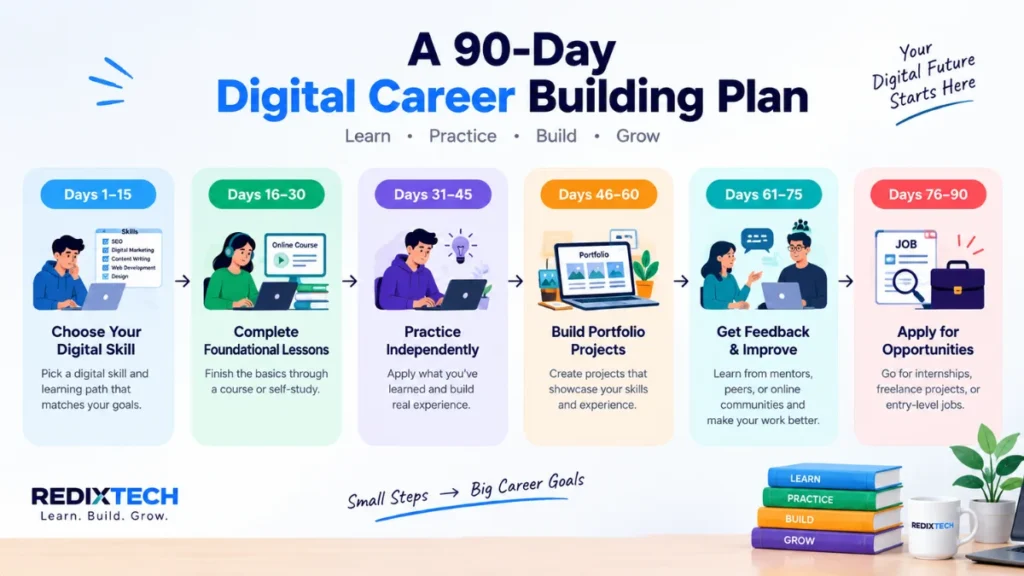
This is a general learning framework, not a guaranteed employment timeline:
- Days 1–15: Choose a digital skill and learning path that matches your goals.
- Days 16–30: Complete foundational lessons through a course or self-study.
- Days 31–45: Practice independently by applying what you have learned.
- Days 46–60: Build portfolio projects that demonstrate your skills.
- Days 61–75: Get feedback from mentors, peers, or online communities and improve your work.
- Days 76–90: Apply for internships, freelance projects, or entry-level opportunities.
Common Mistakes Students Should Avoid
- Choosing courses only for the certificate, without applying the skills.
- Joining an internship without understanding its quality or expectations beforehand.
- Watching tutorials without practicing alongside them.
- Trying to learn too many skills simultaneously instead of focusing.
- Not building a portfolio while learning.
- Ignoring feedback completely.
- Depending entirely on AI and ignoring the need to understand fundamentals.
- Waiting for the “perfect” moment or resource before starting.
- Misrepresenting sample or practice projects as professional client work.
- Expecting instant career success without consistent effort over time.
Frequently Asked Questions
Is an internship better than an online course?
Neither is universally better internships offer practical exposure while online courses offer structured learning. The right choice depends on your goals and current skill level.
Can I build a career through self-learning?
Yes, self-learning can build a strong digital career, especially when combined with consistent practice and a solid portfolio.
Are online courses enough to get a job?
Online courses build foundational skills, but pairing them with practical projects and real-world experience usually improves job readiness.
Does an internship count as work experience?
Generally, yes many employers view internships as relevant experience, though this can vary by industry and region.
Which is better for beginners?
Beginners who need structure often benefit from online courses, while those who prefer independence may do well with self-learning or a combination of both.
Can I combine self-learning with an internship?
Yes, many learners use self-learning to build foundational skills and then apply for internships to gain practical exposure.
How do I build a portfolio while learning online?
Complete course projects and personal practice projects, then showcase them honestly as learning or practice work rather than client work.
Is self-learning better than paid courses?
Not necessarily better it depends on your discipline, learning style, and need for structure versus independence.
How can AI help me learn digital skills?
AI can support research, explanations, feedback, and practice, but it works best as an assistant alongside genuine skill-building, not as a replacement for it.
What is the fastest way to gain practical experience?
Combining structured learning with hands-on personal projects and, where possible, an internship tends to build practical experience more quickly than relying on one method alone.
Final Verdict: Which Is Better for Building a Digital Career?
There is no single winner in the internship vs online course vs self-learning debate. Internships can be valuable for practical exposure, mentorship, and professional experience. Online courses can provide structured learning and strong foundations. Self-learning can provide flexibility and develop independent problem-solving skills.
The strongest approach for many beginners is not choosing only one method. Learn the fundamentals through courses or structured resources, practice independently, build projects, seek feedback, and gain practical exposure through internships or real-world opportunities whenever possible.