Join REDIXTECH’s free 60-day SEO internship in Pakistan. Learn keyword research, technical SEO, link building & Google Analytics on live websites — with mentor guidance and a verifiable certificate. Applications open for 2026 batch. Zero fees. Zero experience needed. Apply now.
Many people just starting out encounter this problem. They enroll in an SEO course, complete it, and get a certificate — yet still can’t explain why a particular page isn’t ranking. It’s not because they didn’t pay attention. Courses teach concepts, not judgement, and you develop judgement only by doing the work, making a few mistakes, and having someone point out what you’ve overlooked.
That’s exactly why you’ll be doing an advanced SEO internship in 2026—you’ll no longer be required to memorise definitions; instead, you’ll audit live pages, write articles that are published under your own name, and deal with any issues that arise.
The article explains just what it actually looks like — the things you’ll learn, why it’s important at the present time, and who ought to be applying.
What counts as an advanced SEO internship?
A basic SEO course generally only covers the surface; it explains what a keyword is and what a backlink is, which is fine for getting started but offers little practical value beyond that.
The advanced internship quickly skips that stage; from day one or two, you get real assignments such as auditing this page, explaining why the meta description is poor, and researching keywords for this niche. You aren’t guided step by step through the process.
The fact that it’s called ‘advanced’ doesn’t mean you need prior SEO experience to join; it simply means the course moves fast and you’re expected to put what you learn into practice right away, not just take notes. By the time it finishes, you should be able to take a typical website and run a simple audit without asking someone else what checks to make.
Internships usually base this kind of work on weekly deliverables—such as an audit in one week, a keyword sheet the following week, and an optimized article afterward. This way, you always have something tangible to show, not just hours spent.
Why SEO Internships Matter in 2026
Search results don’t look like they did two years ago. AI Overviews are answering a chunk of queries right on the results page now. Zero-click searches keep climbing. Google keeps rolling out core updates more often than it used to. Ranking a page in 2026 takes more than dropping keywords in the right spots — you have to understand what Google’s actually trying to reward with each update.
A few reasons this is worth your time right now:
SEO is one of the only marketing skills you can build entirely from home. That matters if you’re outside a big city and don’t have agency jobs nearby — which, let’s be honest, describes a lot of people trying to break into this field from smaller towns. There’s no marketing degree required to start, but the ceiling is high — people who stick with it end up consulting, running agencies, or leading in-house teams.
AI hasn’t killed the need for SEO people. It’s just changed what the job looks like. Google’s gotten noticeably better at catching thin, AI-written filler, so the interns who actually stand out are the ones who use AI to speed up their research without letting the final content read like a robot wrote it. And nearly every business with a website — a dental clinic, a clothing brand, a SaaS company — needs somebody who at least understands the basics of showing up on Google.
What You’ll Actually Learn
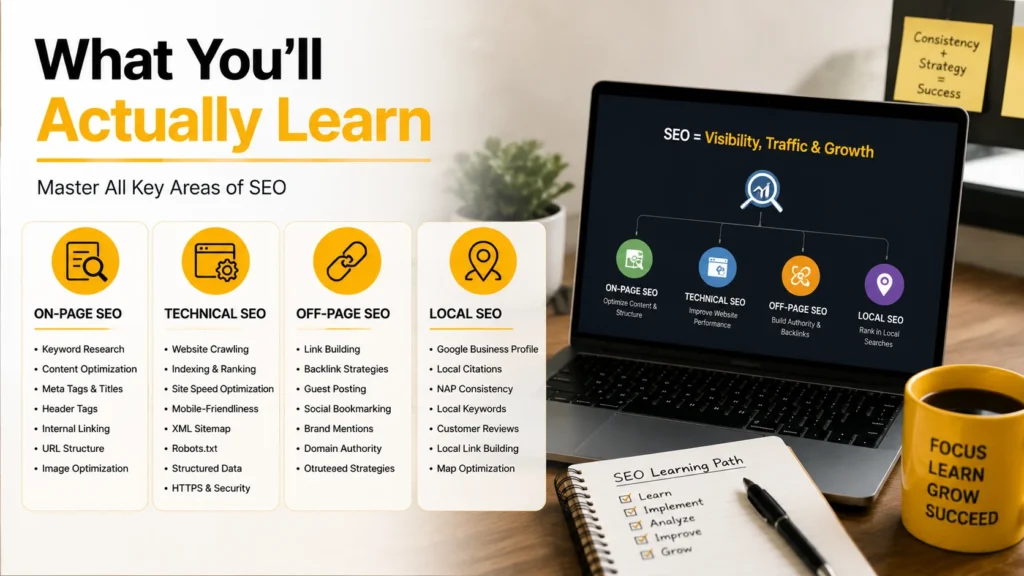
A good internship doesn’t just have you writing blog posts all day. It covers the technical backend of a site plus the content strategy sitting on top of it.
Technical SEO
Most beginners skip this part, which is exactly why it’s where interns learn the most. Site speed, crawlability, indexation, sitemaps, robots.txt setup, schema markup — all of it. A page can be written perfectly and still never rank if Google can’t crawl it properly in the first place. Technical SEO is where you learn to spot that kind of problem before it wastes weeks of content work.
On-Page SEO
This is usually where your first real task lands. Title tags, meta descriptions, header structure, internal links, alt text, and optimizing around a target keyword without cramming it in unnaturally. It’s hands-on and the results are easy to check, which is probably why it’s the most common starting point.
Off-Page SEO & Link Building
Building authority outside your own site — backlinks, guest posts, digital PR. Interns usually learn pretty fast that not all links are equal. A backlink from a relevant, high-authority site does more than ten random low-quality ones stacked together.
Keyword Research & Competitor Analysis
You learn to figure out what people are actually typing into Google — using something like Google Keyword Planner, Ubersuggest, or Ahrefs — and to read the intent behind it. Is this person trying to buy something, compare options, or just learn? Competitor analysis is the other half: looking at what’s already sitting on page one and figuring out why. Word count, structure, keyword placement, backlink profile. Then building something better.
Local SEO
If the internship works with local clients, expect Google Business Profile optimization, citations, and location-based keyword work. In a market like Pakistan, where a lot of small businesses are only just starting to take local search seriously, this is a genuinely useful skill to have going into a job interview.
SEO Tools & AI in SEO
Google Search Console and Analytics — you’ll be in these constantly, checking impressions, clicks, indexing status. On top of that, most programs now teach AI-assisted workflows too: using AI for outlines or topic clustering while keeping the actual writing and fact-checking in human hands. Knowing when AI genuinely saves time versus when it just produces generic filler is becoming its own skill worth having.
Real-World SEO Projects
This is the actual difference between an internship and a course. No sample exercises. You’re auditing a real website, publishing an article that goes live, and watching how it actually performs over the following weeks.
Portfolio Building
Every audit, keyword sheet, and article you finish becomes something you can show later. By the end, you want an actual portfolio — not just a certificate sitting in a folder somewhere.
Internship Benefits & Career Opportunities
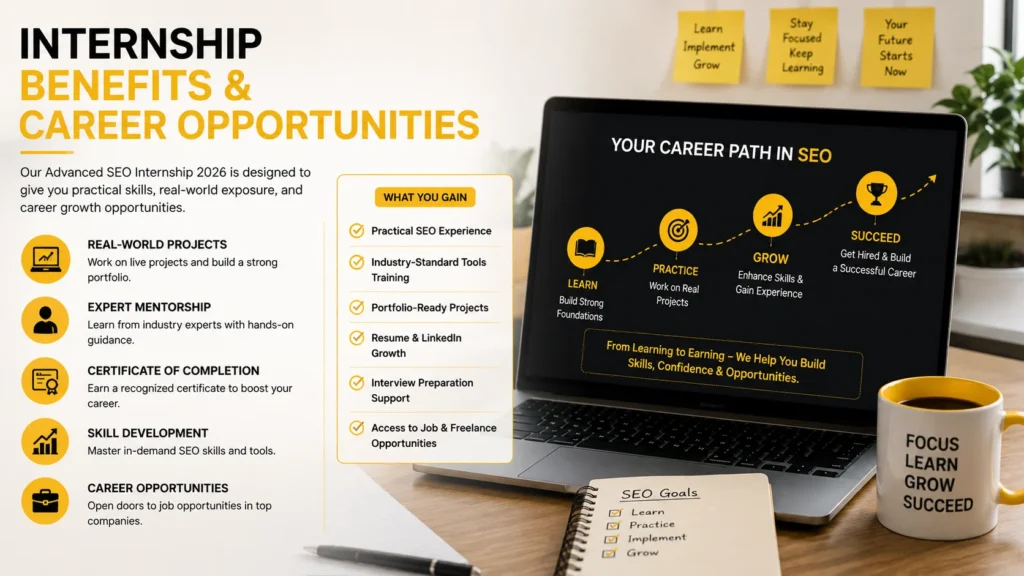
Finishing a digital marketing internship focused on SEO opens more than one door. Some people start picking up small freelance clients on Fiverr or Upwork before the internship’s even done. Others go straight into agency roles as SEO executives or content strategists — probably the most common first job title you’ll see. In-house teams want SEO knowledge too now, even at companies that aren’t primarily digital businesses. Give it a few years and a lot of SEO people end up moving into strategy work, consulting, or starting their own agency.
The real payoff isn’t the job title, though. It’s learning to make decisions based on actual numbers — search volume, click-through rate, ranking position — instead of guessing what sounds right and hoping.
Who Should Apply?
An SEO internship for beginners, or an advanced one if you’ve already got some foundation, is worth applying to if any of this sounds like you:
You’re a student or recent grad figuring out where to start in digital marketing. You already write decently and want to add something more technical and measurable on top of that. You’re freelancing already and want to add SEO as a service you can offer. You’re switching careers entirely and need real project work, not another certificate to add to a pile. Or you’re just genuinely curious how search actually works, past the surface-level tips floating around online.
You don’t need to walk in as a “technical person.” Most advanced programs are built for people starting with little to no SEO background at all.
FAQs
Do I need to know how to code for an SEO internship?
No. Understanding schema markup or page speed doesn’t require coding. Knowing basic HTML/CSS helps when you’re reading a page’s source, but it’s not a requirement to get started.
Is an SEO internship in Pakistan worth as much as an international one?
Yes. SEO doesn’t care where you’re located — clients care about results. A lot of interns based in Pakistan end up working remotely with clients in the US, UK, or Gulf region without it being an issue at all.
How long does an advanced SEO internship usually take?
Most run somewhere between a few weeks and a month, with tasks and feedback happening throughout rather than one big project dumped at the end.
Will I get a job right after finishing one of these?
It helps a lot, especially with a real portfolio behind you. But landing the job still comes down to how well you can talk through your work in an interview and whether you keep learning past the program.
What’s actually different between an SEO training internship and a free course online?
A course teaches concepts on their own. An internship puts those same concepts into a live project with real feedback attached—which is much closer to what an actual job looks like.
Conclusion
SEO in 2026 isn’t just about placing the right keywords anymore. It rewards people who understand the technical side of a site and the content strategy sitting on top of it. An advanced SEO internship is one of the fastest ways to build both — because you’re learning by doing it, not by watching someone else explain it.
If you’re serious about starting an SEO career this year, Redixtech runs project-based internship tracks where you work on real websites from day one and walk away with an actual portfolio — not just a certificate.