Explore the latest Google Algorithm Update in 2026, including core and spam updates, AI changes, ranking fluctuations, and SEO strategies to adapt.
Introduction
In 2026, Google is bringing a lot of changes to its search algorithm — sometimes a core
update, sometimes a spam update, and now AI has also become a big part of search. With
every updates, rankings go through ups and downs, so it’s important for SEO professionals
and website owners to understand these change. In this article, we’ll discuss the latest
Google algorithm updates of 2026, the new features of Gemini AI, and how SEO
professionals should adapt to these changes.
What Are Google Algorithm Updates?
Google algorithm updates are changes that Google makes to its search system in order to
make results better and more accurate. There are two types of these — core updates and
spam updates. In a cores updates, Google re-evaluates the content quality of the entire
website, while a spam update only targets websites that violate Google’s spam policies.
These updates can move rankings up or down, so every website owner should know about
these updates.
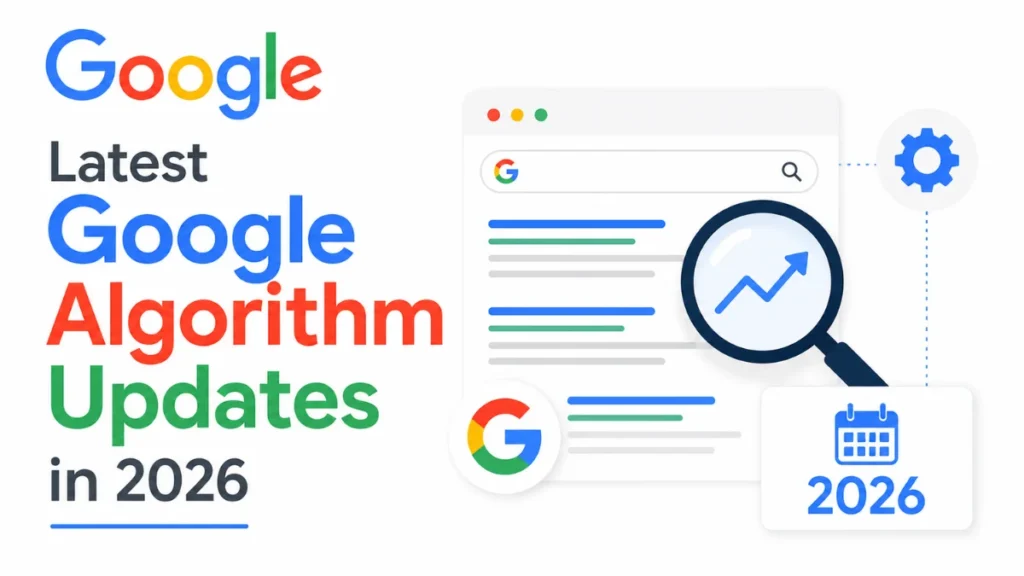
Latest Google Algorithm Updates in 2026
So far in 2026, Google has released several importent updates — some were core updates
and some were spam updates. Below is a shorts overview of each.
March 2026 Core Update
This was the first core update of 2026, which started on March 27 and completed on April 8
— a total of 12 days. This updates arrived just 3 days after the March spams update
finished, so it became difficult for many websites to understand which update caused their
ranking drop. Being a cores update, it re-evaluated the content quality of the entire website,
rather than targeting anything specific.
March 2026 Spam Update
This was the first spam update of 2026, which started on March 24 and completed in just 19
hours and 30 minutes — the fastest rollout record so far. Google said this was a “normal
spam update” that was globals and applied to all languages. It specifically targeted websites
that violated Google spam policies.
May 2026 Core Update
This was the second core update of 2026, which starteds on May 21 and completed on June
2 — a total of 11 days and 21 hours. During this update, quite a lot of volatility was seen in
rankings, especially on May 23, May 30, and the last day. The SEO community noticed that
websites that updated regularly and provided expert content suffered less damage in this
update.
June 2026 Spam Update
This was the second spam update of 2026, which started on June 24 and completed on
June 26 — a total of 2 days. Google clarified that this was a normal spam update that did not
target link spam or the site reputation abuse policy. Along with this update, Google also
stated that its spam policies now also apply to attempts to manipulate AI-generated
responses.
August 2026 Spam Update
This was the third spam update of 2026, which started on August 18 and completed on
August 21 — a total of 2 days and 16 hours, the longest among all three spam updates of
the year. This was also global and applied to all languages. Google did not announce any
new policy with this update, so the existing spam policies were the rules to check against.
What Is the August 2026 Google Spam Update?
The August 2026 spam update was Google’s third spam update of the year. It started on
August 18, 2026 and completed on August 21, 2026 — a total of 2 days and 16 hours. This
update was global, meaning it applied to websites all over the world, and covered all
languages. Google did not announce any new spam policy with this update — meaning
whatever rules already existed were the ones followed in this update as well. This update
targeted websites that were violating Google’s existing spam policies, such as low-quality or
manipulatives content. If any websites ranking dropped during this update, site owner should
review Google’s spam policies again, look for any violation on their site, and fix it. Recovery
can take time — sometimes even months — so it’s important to be patient.
What Is New in Google Search in 2026?
In 2026, Google Search has become very AI-focused. AI Mode, which is a new search
experience, is now being used by more than a billion monthly users. AI Overviews — which
show an AI-generated summary at the top of search results — now appear on more than
20% of searches. What’s interesting is that around 68% of US searches now end without
clicking on any link, because AI itself gives users a direct answer. Gemini AI is now deeplly
integrated with Google Search, which makes results more conversational and accurate. New
features are also being added to Search Console so that website owners can see AI-related
performance data. Social and video content — such as short videos and social posts — are
also now appearing more in search results, because people no longer search for just text but
also visual content.
Latest Google Gemini Updates in 2026
In 2026, Google is rapidly updating its Gemini AI models. On Aug 13, 2026, Google
launched Gemini 3.7 Flash, which is a fast and powerful model for coding and AI agents — it
arrived just 3 weeks after its previous model, Gemini 3.6 Flash. This new model is being
used first in Gemini Spark, which is Google’s personal AI agent — it helps organize files,
draft emails, and complete tasks across Google Workspace apps like Gmail, Drive, Docs,
and Calendar.
Gemini Spark is now also integrated into the Chrome browser, letting it
browse websites, compare flights, and start bookings using the user’s saved passwords and
logins — but it hands control back to the user for sensitive things like payments. Gemini
Spark is now available in more than 160 countries, but only for Google AI Pro or Ultra
subscribers. These updates show that Google is connecting its different products — Search,
Chrome, and Workspace — with each other more and more.
What Is Gemini Spark?
Gemini Spark is a personal AI agent from Google, available to AI Pro or Ultra subscribers. Its
main purpose is to automate the user’s everyday tasks — such as organizing files, drafting
emails, and updating status documents. What’s special is that Gemini Spark keeps working
even after a laptop is closed or a phone is locked, and it can operate across multiple Google
services at once, like Gmail, Drive, Docs, Calendar, Keep, and Tasks. It has now also been
integrated into the Chrome browser, letting it navigate websites using the user’s already
signed-in accounts and saved passwords — such as comparing flights, scheduling
apartment viewings, or starting bookings. But whenever a sensitive step like payment comes
up, Gemini Spark hands control back to the user to keep things secure.
How Google Gemini Is Changing SEO in 2026
Gemini AI has changed the way SEO works quite a bit. Earlier, Google used to show results
just by matching keywords, but now, with Gemini’s help, Google tries to understand the
user’s real search intent — meaning it understands not just the words, but the user’s actual
purpose. Now, AI itself generates the answer for many searches (through AI Overviews),
which means users no longer need to click on a website — this affects “content visibility,”
because just ranking at the top isn’t enough anymore, being cited in the AI’s answer has also
become important.
Gemini also understands “entities” — meaning the connections between
brands, people, and topics — so clarity and structure in content have become more
important than before. But it’s important to remember that traditional SEO (such as quality
content, backlinks, and technical SEO) still matters, because AI systems also use that same
trusted, well-optimized content to build their answers.
How Should SEO Professional Adapt to Google,s Update for 2026?
SEO professionals should always write people-first, original content that reflect real expertise
and experience. They should avoid spam tactics like keyword stuffing or fake reviews,
because these are exactly the things Google’s spam updates target. Technicals SEO also
needs attentions — such as site speeds, mobiles-friendliness, and clean structure. Regularly
monitorings Google Search Console helps spot problems early, while analyzing traffic shows
what’s actually working. Old content should also be updated from time to time so it stays
accurate and related. The most important thing: professionals should always optimize for
real users, not just for the algorithm.
Google AI Search & SEO: What Has NOT Changed?
Despite so many AI-related changes, some of the basics of SEO are still exactly the same
as before. Quality content still matters the most — whether it’s for an AI Overview or normal
search results, Google (and its AI) both prioritize helpful and accurate content. Backlinks still
work as a trust signal, showing that other websites consider your content valuable. Technical
SEO — such as fast loading speed, mobile-friendly design, and clean site structure — is still
just as important as before, because AI systems also depend on these same things to crawl
and index. User experience is also a core factor — if people come to your site and leave
quickly, this is considered a negative signal. Finally, keyword research is also necessary —
only the method has changed slightly, intent-based keywords have now become more
important, but doing the research is still just as necessary.
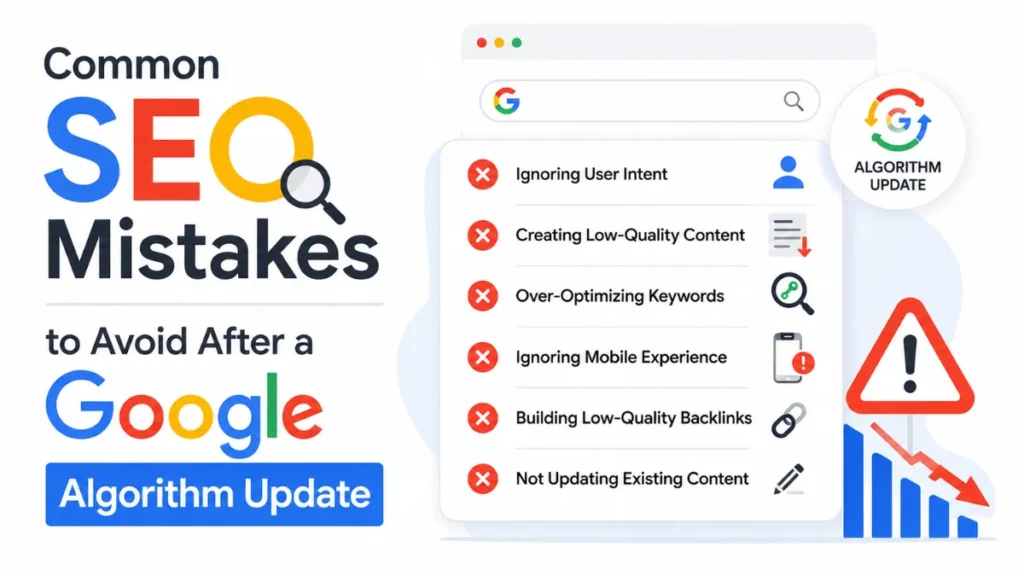
Common SEO Mistakes to Avoid After a Google Algorithm Update
After a Google update, people make quite a few common mistakes. The first is rewriting the
entire website immediately out of panic, when analyzing first is actually better. The second is
not being able to understand whether a core update hit them or a spam update — both need
a different approach. The third is not checking Search Console just because of a traffic drop,
when that’s exactly where the most useful information comes from. The fourth is repeatedly
making small edits to content without any clear strategy, which creates even more confusion.
Finally, expecting recovery too quickly, when Google itself says it can take weeks or months.
FAQs
Q1: How many algorithm updates has Google rolled out in 2026 so far?
As of now, Google has confirmed 5 updates in 2026 — two core updates in March and May, plus three spam updates spread across March, June, and August.
Q2: What’s the actual difference between a core update and a spam update?
A core update takes a broad look at content quality across the entire site, while a spam update is more focused — it goes after sites breaking Google’s spam rules specifically.
Q3: My website’s ranking just dropped — what should I do first?
Start by figuring out which update was rolling out around that time, then dig into Search Console for clues, and check your site against whatever Google guidelines are relevant — spam or quality.
Q4: How long until rankings bounce back after an update?
There’s no fixed timeline — it depends on the update itself, but Google has said more than once that recovery can stretch anywhere from a few weeks to several months.
Q5: Has traditional SEO become useless because of AI Overviews?
No, traditional SEO is still important — quality content, backlinks, and technical SEO matter just as much for AI systems as they do for normal search.
Conclusion
In 2026, Google rolled out several important algorithm updates — the March, May, June, and
August spam and core updates — while Gemini also saw major progress, including Gemini
3.7 Flash and Gemini Spark. But despite all these changes, one thing remains clear: Google
still rewards genuine, helpful, people-first content. the rise of AI hasn’t made traditional SEO
obsolete — if anything, it’s made it more importents for content to deliver real value.
Marketers and content creators should keep following Google’s official updates, keep their
content current, and focus on writing for real users rather than just trying to please the
algorithm.